Commercial Roof Repair or Replacement: How New Jersey Building Owners Decide
The Short Answer
- Repair when the water traces to one place: a seam, a flashing at a wall or curb, or a pipe or unit penetration, and the membrane and insulation around it are dry and sound.
- Restore (a coating over the existing roof) only when the membrane is weathered but still watertight and the insulation under it is dry.
- Replace when leaks keep appearing in different places, the insulation is wet, large areas of membrane are split, blistered or shrinking, or the roof has had repair after repair.
- Age counts too: a roof near the end of its expected service life, with repairs adding up, is one to plan replacement for, even when each leak on its own is small.
- New Jersey permit: the state's no-permit list names roof-covering work only on detached one- and two-family homes. On offices, shops, factories and warehouses, repair or renovation can be "minor work": notice to the town's construction office before work begins, and a permit application within five business days.
- New Jersey insulation: if the work exposes the roof deck over heated or cooled space, accessible voids in the insulation have to be filled to the commercial energy code's R-values.
Each rule comes from a source listed at the foot of the page, read on November 5, 2026. R&E Roofing's prices are in a written estimate for your building, not on this page.
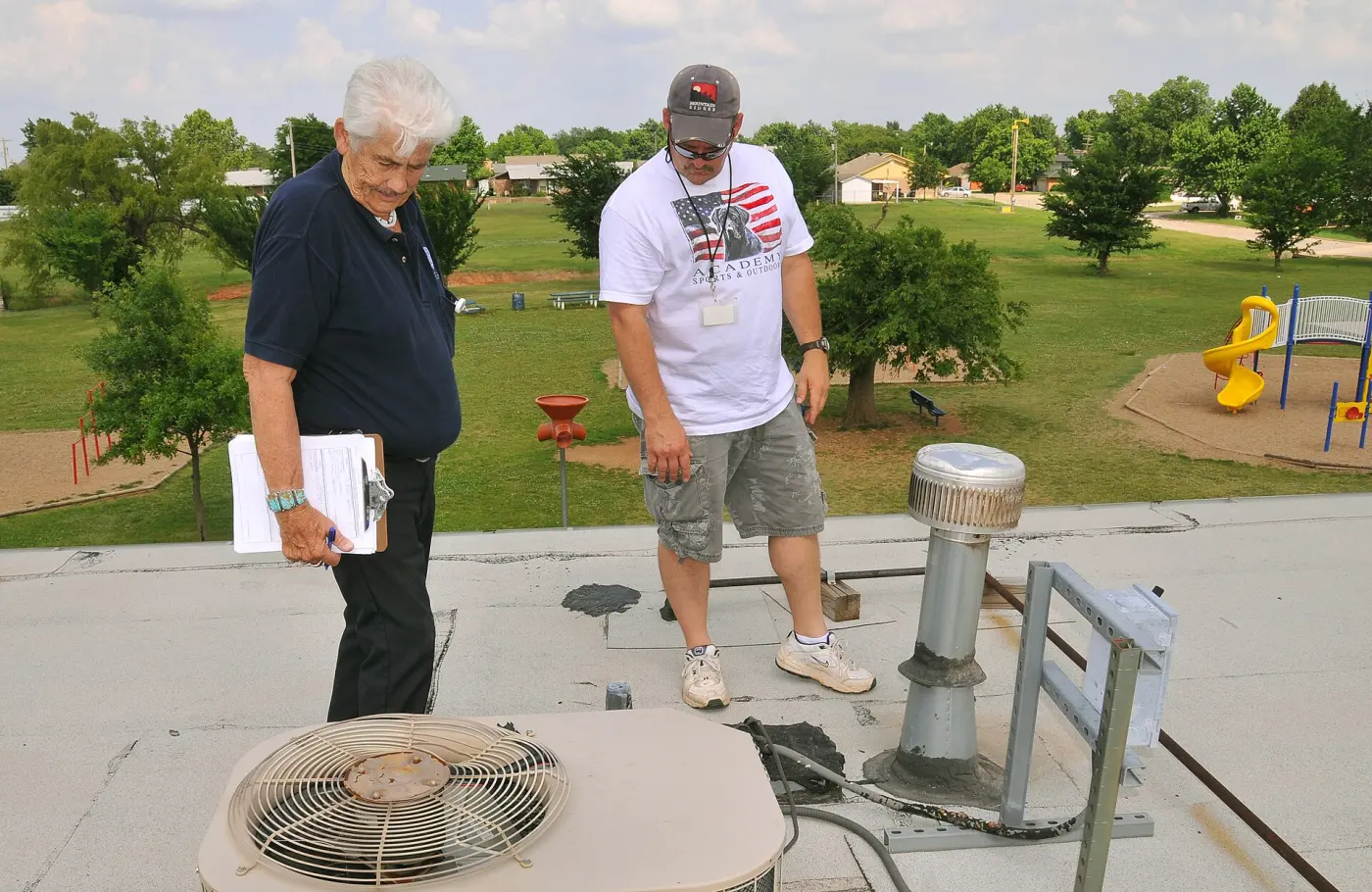
Searched from Orange on November 5, 2026, "commercial roof replacement" on a phone returned roofers' service pages, and only one of the first ten was written for New Jersey. The top three did not cover what New Jersey asks for before a commercial roof is opened. This page sets out how to tell a repair job from a replacement, the state rules that change the job, and what to send so an estimate fits the building.
1. Repair, Restore or Replace: The Signs for Each
The decision turns on two questions: is the water coming from one place or many, and is the insulation under the membrane still dry? A single failed seam on a dry roof is a repair. Wet insulation under the membrane is not fixed by a patch on top.
| What you see | Points to |
|---|---|
| One ceiling stain under a rooftop unit, a pipe or a wall | Repair the flashing or penetration it traces to |
| A split or open seam, a puncture from foot traffic or a dropped tool | Repair with the same membrane type |
| Water standing in the same spot after rain, a slow or blocked drain | Clear or repair the drain first, then judge the membrane around it |
| Surface chalking or crazing on a roof that does not leak, dry insulation underneath | Restoration coating may be an option |
| Leaks in several places, or a new leak after each repair | Plan replacement |
| Roof near the end of its expected service life, with repairs adding up | Plan replacement |
| Soft or spongy areas underfoot, wet insulation found in a core cut | Replace at least the wet area; the whole roof if the wet area is large |
| Widespread blistering, shrinking membrane pulling at the edges, cracked flashings all round | Plan replacement |
R&E Roofing's commercial roof repair service lists roof restoration (coatings) among its commercial services, next to flat roof repair, emergency roof repair and preventive maintenance.
2. What an Assessment Should Check Before Anyone Quotes
A repair-or-replace answer is only as good as the look behind it. In the National Roofing Contractors Association's description, a preventive maintenance inspection is a thorough visual inspection of the roof system and its adjacent surfaces, such as walls, as well as any mechanical equipment that can affect the roof system's watertightness, with conditions documented in writing and photographed. For a repair-or-replace call, ask that the visit covers:
- Membrane and seams: splits, open laps, blisters, punctures and shrinkage at the edges.
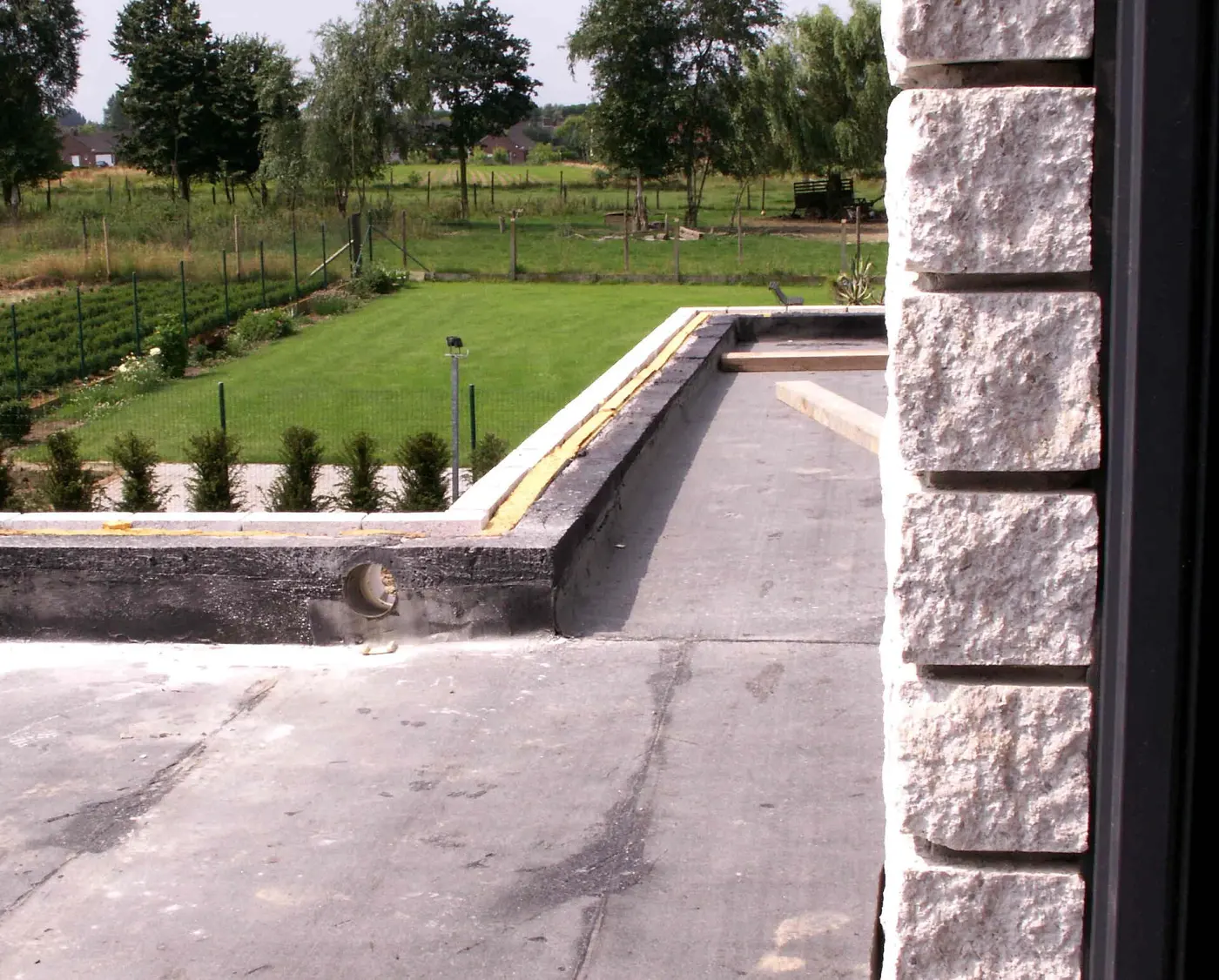
- Flashings: at parapet walls, curbs under rooftop units, expansion joints and the roof edge.
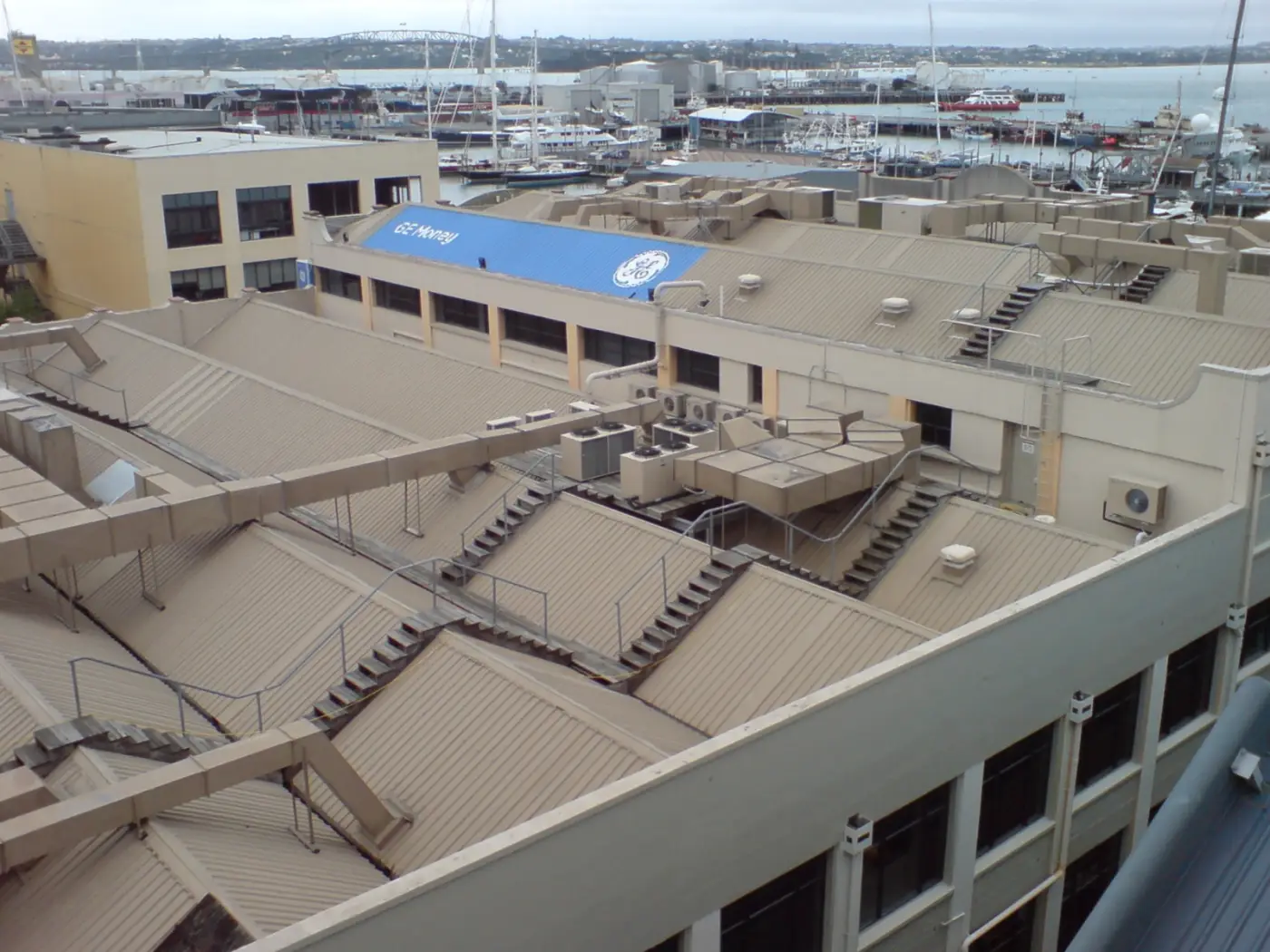
- Penetrations and equipment: pipes, vents, hatches, skylights and every unit on the roof, plus the walkway route service technicians take to reach them.
- Drains, scuppers and gutters: open, flowing, and with no water standing around them.
- Insulation moisture: a core cut or a moisture scan in the areas over stains, because wet insulation decides repair or replace.
- The inside: ceiling stains, wet tiles and the deck underside where it can be seen.
- The record: earlier repairs, the roof's age and any manufacturer warranty paperwork you hold.
3. New Jersey Rules That Change the Job
Commercial roof work in New Jersey runs under the state's Uniform Construction Code (N.J.A.C. 5:23), enforced by the local construction office. Four parts of it matter before a roof is opened.
The no-permit list stops at one- and two-family homes
N.J.A.C. 5:23-2.7 lists ordinary maintenance, the work that needs no permit, inspection or notice. Its roofing item reads: "The repair or replacement of existing roof covering on detached one- and two-family dwellings." A store, office, factory or warehouse is not on that line. The rule also says the list "is not an all-inclusive listing," so the town's construction office is the one to confirm what a given job needs.
Minor work: notice first, permit application within five business days
N.J.A.C. 5:23-2.17A defines minor work to include "repair and/or renovation work in a Group B, Group F, Group M, or Group S occupancy performed in accordance with N.J.A.C. 5:23-6." Those are the building code's business, factory/industrial, mercantile and storage groups (2021 International Building Code, Section 302.1). For minor work, a permit is not needed before work proceeds, but the owner, or an architect or contractor acting for the owner, must give notice to the enforcing agency before work begins, and file the permit application within five business days of the notice. The fee is paid before the permit is issued.
An exposed deck brings the insulation rule in
Under the rehabilitation subcode's renovation section (N.J.A.C. 5:23-6.5), when the work "creates or exposes the roof decking/sheathing or the framing" of a roof that is part of the building thermal envelope, "any accessible voids in insulation shall be filled using insulation meeting the R-values" of Table 5.5-4 or 5.5-5 of the commercial energy code. New Jersey's energy subcode handles commercial buildings by means of ASHRAE Standard 90.1 (N.J.A.C. 5:23-3.18). A full tear-off exposes the deck, so the insulation line belongs in the replacement estimate from the start, not as a change order.
The building code behind it, and the "25% rule"
New Jersey adopts the 2021 International Building Code as its building subcode (N.J.A.C. 5:23-3.14). Its state amendments to the roof chapter send the secondary (emergency overflow) drains and scuppers of Section 1502 to the state plumbing subcode, which matters when a replacement changes how the roof drains.
The "25% rule" that comes up in searches is a Florida Building Code rule: not more than 25 percent of a roof area or roof section may be repaired, replaced or recovered in any 12-month period unless the whole roof or section is brought to code, with an exception since May 27, 2022 for roofs built or repaired under the 2007 Florida Building Code or later. In New Jersey's ordinary-maintenance rule, the 25 percent limits are for interior finishes in one- and two-family dwellings and for siding on other buildings, not for roofing.
4. Newark-Area Weather and a Low-Slope Roof
NOAA's 1991-2020 climate normals for its Newark airport station (Newark Intl AP) give the weather a flat roof in the area takes in an average year:
| Normal (Newark airport, 1991-2020) | Value |
|---|---|
| Precipitation a year | 46.60 inches |
| Days with 0.50 inch of precipitation or more | 32.5 |
| Snowfall a year | 31.5 inches (24.6 in December to February) |
| Days with a low of 32°F or colder | 79.9 |
Water that stands on a membrane after a heavy rain can freeze on one of those cold nights, and snow sits on a low-slope roof instead of sliding off. NRCA recommends roof maintenance inspections at least biannually, preferably in spring and fall, plus additional inspections after severe weather such as a hurricane, tornado or hailstorm. Here that timing lines up with the seasons: a spring visit finds what winter opened, and a fall visit clears drains and closes seams before the cold months.
5. What a Replacement Involves
A written replacement scope should answer each of these, so two estimates can be compared line by line:
- Tear-off or recover. Whether the old membrane and insulation come off to the deck, or a new system goes over the old one, and why. A recover keeps wet insulation in the roof, so a moisture check comes first.
- Deck repairs. How damaged decking found after tear-off is priced.
- Insulation. The thickness and R-value going back on, against the New Jersey rule above.
- Membrane. TPO, EPDM, PVC, modified bitumen, built-up or metal, and the thickness of the sheet.
- Flashings and equipment. New flashings at walls, curbs and penetrations; who disconnects and resets rooftop units if curbs have to be raised.
- Drainage. Drains, scuppers and any tapered insulation to move water off low spots.
- Paperwork. Who gives notice or files the permit with the town, and which manufacturer warranty, if any, the system carries and who registers it.
- Keeping the building dry. How each day's tear-off is closed in before the crew leaves, and how tenants are told.
The membrane options, building by building, are on R&E's commercial flat roof repair and replacement page, and published price ranges by membrane are in the New Jersey commercial roofing cost guide.
6. What to Send for an Estimate, and What to Ask
R&E Roofing's commercial page asks for five things so fit and availability can be confirmed:
- The building address
- The building type (office, retail, warehouse, mixed use)
- The approximate roof area
- How the roof is reached (hatch, ladder, stair)
- The current condition: where water shows inside, since when, and any earlier repairs
Questions worth asking any commercial roofer, R&E included:
- Is this a repair, a restoration or a replacement, and why?
- Will you check the insulation for moisture before deciding?
- Who gives notice to the town or files the permit, and under which category?
- If the deck is exposed, what insulation goes back on to meet the New Jersey rule?
- Will you send a certificate of insurance naming the building owner before work starts?
- What written warranty comes with the work, from whom, and for how long?
For help comparing roofers, see how to choose a commercial roof repair company. For water coming in now, see the emergency commercial roof repair page.
7. Commercial Roof Repair and Replacement FAQs
Should I repair or replace my commercial roof?
Repair when the water traces to one place, such as a seam, a flashing at a wall or curb, or a pipe or unit penetration, and the membrane and insulation around it are dry and sound. Replace when leaks keep appearing in different places, the insulation under the membrane is wet, large areas of membrane are split, blistered or shrinking, or the roof has already had repair after repair. A coating (restoration) is a middle option only when the membrane is still watertight and the insulation is dry.
What is the life expectancy of a commercial roof?
There is no single number. NRCA's technical staff wrote in Professional Roofing in October 2007 that, to the best of NRCA's knowledge, there is "no reliable, unbiased accumulation of data that establishes the service lives of various low- or steep-slope roof systems." One published figure comes from interviews and a survey, not from testing: a study funded by the Roofing Industry Alliance for Progress, reported in Professional Roofing in November 2003, put the average low-slope roof system life span at about 17 years, counted from installation to re-cover or replacement. The owners, architects and contractors surveyed named installation quality, weather conditions and proper maintenance as the most relevant indicators of how long a roof lasts, and the study's model also weighed material type and thickness, region, insulation and maintenance practices. A roof's age tells you when to start planning; the condition of its membrane, seams, flashings, drains and insulation tells you whether the time has come.
Do I need a permit to replace a commercial roof in New Jersey?
New Jersey's ordinary-maintenance list, the work that needs no permit, inspection or notice, names the repair or replacement of existing roof covering only on detached one- and two-family dwellings (N.J.A.C. 5:23-2.7). The rule says that list is not all-inclusive. For business, factory, mercantile and storage buildings (Groups B, F, M and S), repair or renovation work done under the rehabilitation subcode can be minor work: notice to the town's construction office before work begins, then a permit application within five business days (N.J.A.C. 5:23-2.17A). Ask the town's construction office which applies before the roof is opened.
Does a new commercial roof have to meet insulation rules in New Jersey?
When renovation work creates or exposes the roof decking or framing of a roof that encloses heated or cooled space, New Jersey's rehabilitation subcode requires any accessible voids in insulation to be filled with insulation meeting the R-values of Table 5.5-4 or 5.5-5 of the commercial energy code, as applicable (N.J.A.C. 5:23-6.5). New Jersey's energy subcode handles commercial buildings by means of ASHRAE Standard 90.1 (N.J.A.C. 5:23-3.18).
What is the 25% rule for roofing?
The rule people call the 25% rule is in the Florida Building Code: not more than 25 percent of a roof area or roof section may be repaired, replaced or recovered in any 12-month period unless the roof covering on the whole roof or section is brought to code, with an exception added in 2022 for roofs built or repaired under the 2007 Florida Building Code or later (Florida Roofing and Sheet Metal Contractors Association, 2018 and 2023). In New Jersey's ordinary-maintenance rule, the 25 percent limits are for interior finishes in one- and two-family dwellings and for siding on other buildings, not for roofing.
How often should a commercial roof be inspected?
The National Roofing Contractors Association recommends roof system maintenance inspections at least biannually, preferably in spring and fall, plus additional inspections after severe weather such as a hurricane, tornado or hailstorm (Professional Roofing, April 2012). Newark's airport averages 79.9 days a year with a low of 32 degrees F or colder and 31.5 inches of snow (NOAA 1991-2020 normals), so the fall visit is the one that checks drains and seams before freeze-thaw season.
How much does it cost to replace a commercial roof?
R&E Roofing does not publish a commercial roof price; it gives a written estimate for the building after it knows the address, building type, approximate roof area, access and current condition. The price moves with the roof area, how many layers come off, whether wet insulation has to be replaced, the insulation the code asks for once the deck is exposed, the membrane chosen, and the flashings, curbs and drains around rooftop equipment. Published ranges by membrane are in R&E's commercial roofing cost guide for New Jersey.
What type of roof do commercial buildings use?
Low-slope commercial roofs are covered with single-ply membranes (TPO, EPDM or PVC), modified bitumen, built-up (tar and gravel) roofing, or metal panels. The repair has to match the membrane: TPO and PVC seams are heat-welded, while EPDM seams are adhesive-bonded rather than welded, so the repair material has to be compatible with the roof that is there.
Does R&E Roofing work on commercial roofs?
Yes. R&E Roofing handles commercial flat and low-slope roof repair and replacement requests in Essex County from its office at 573 Valley Street in Orange, NJ. Office hours are Monday to Friday, 9 to 5, and R&E takes emergency calls on nights and weekends. Call (667) 204-1609 with the address, building type, approximate roof area, access and current condition.
Sources
All read on November 5, 2026.
- N.J.A.C. 5:23-2.7, Ordinary maintenance (Cornell LII): law.cornell.edu
- N.J.A.C. 5:23-2.17A, Minor work (Cornell LII): law.cornell.edu
- N.J.A.C. 5:23-6.5, Renovations (Cornell LII): law.cornell.edu
- N.J.A.C. 5:23-3.14, Building subcode, and 5:23-3.18, Energy subcode (Cornell LII): 3.14, 3.18
- International Code Council, 2021 IBC Occupancy Classification and Mixed Occupancies (Section 302.1 groups): iccsafe.org (PDF)
- NOAA NCEI, 1991-2020 annual and seasonal normals, station USW00014734 (Newark Intl AP, NJ): ncei.noaa.gov
- Mark S. Graham, "Tech Today," Professional Roofing (NRCA), April 2012: professionalroofing.net
- Joan P. Crowe, "Technical Elements," Professional Roofing (NRCA), October 2007, on roof system service-life data: professionalroofing.net
- Ambika Puniani Reid, "Evidence of depreciation," Professional Roofing (NRCA), November 2003, on the Roofing Industry Alliance for Progress life-span study: professionalroofing.net
- Florida Roofing and Sheet Metal Contractors Association, "Florida Building Code's 25 Percent Rule Causes Confusion" (2018) and "Current and Coming Changes to the 25% Rule" (2023): 2018, 2023
- R&E Roofing, commercial flat roof repair and replacement: randeroofing.com/services/commercial-roofing