Heated Gutters & Roof Heat Cable in Essex County, NJ: Installed Cost, Where It Goes, and When It's Worth It
The Short Answer
- Installed cost: HomeAdvisor (June 2026) puts a roof heating cable job at $900 to $1,800, average $1,400. It puts heated gutters at $475 to $4,000. GutterBrush (October 2024) gives $500 to $2,000 for installation, plus $10 to $25 a foot for cable. National figures, not R&E prices.
- Running cost in Essex County: 100 feet of self-regulating cable uses about 23 kWh a day at 32°F, around the clock. At PSE&G's residential price to compare of about 19.8 cents a kWh (energy plus transmission, effective October 1, 2026), that is about $4.56 a day before distribution charges. A thermostat cuts it to roughly a third.
- Where it goes: a zigzag along the lower roof edge, the bottom of the gutter, and down every downspout. On the pre-1940 houses of Glen Ridge, Montclair and Maplewood, it goes inside the built-in box gutters.
- When it is worth it: for one or two eaves that ice up every winter after the attic has been fixed. Cable keeps a drain channel open. It does not stop the dam from forming.
Every price on this page is quoted from the named source with its date. None of them is R&E Roofing's price.
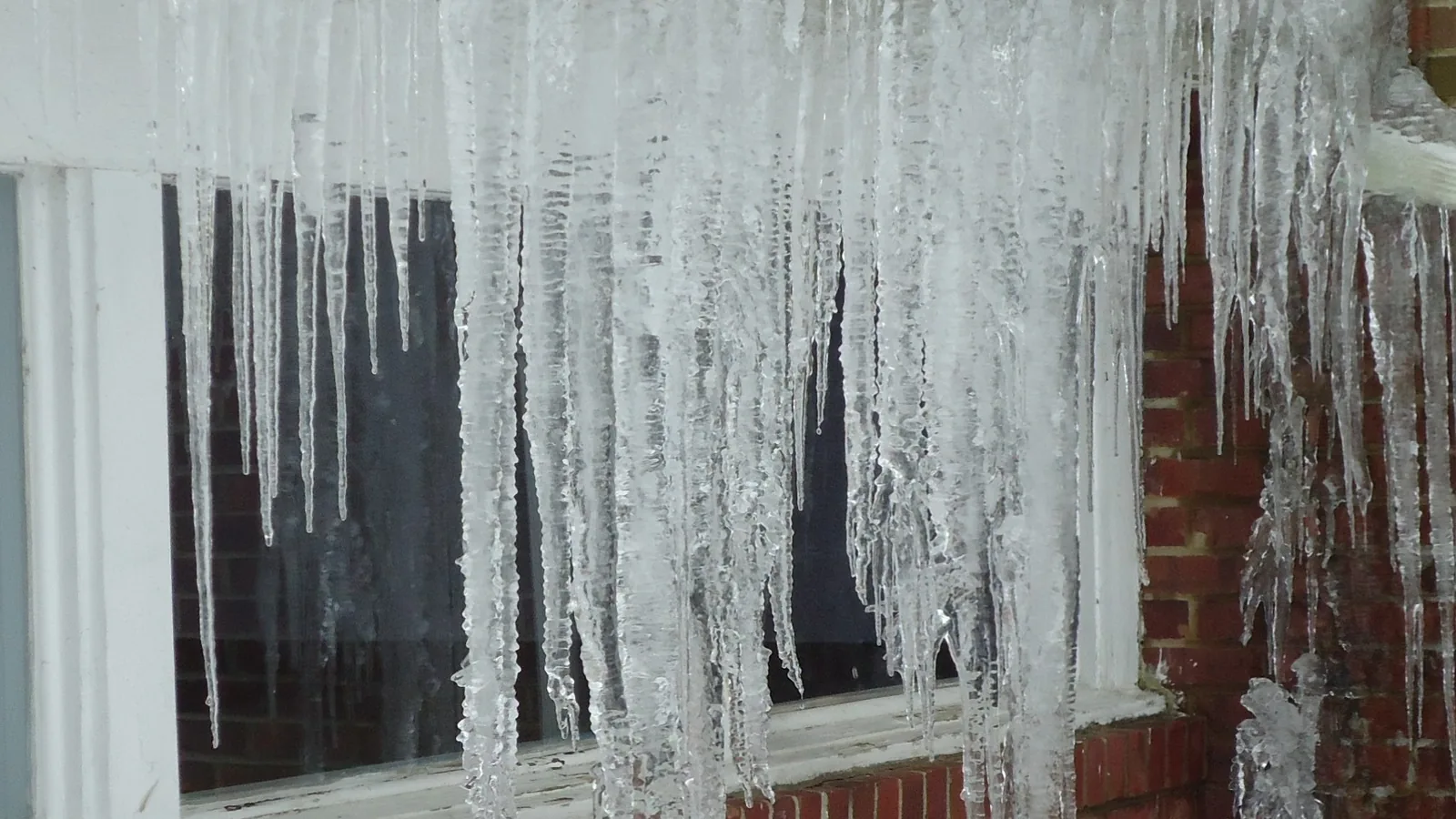
Heated gutters are ordinary gutters with an electric heating cable inside. The cable runs along the bottom and down the downspout. Roof heat cable is the same cable clipped in a zigzag along the roof edge. Both do one job. They melt a channel through the ice so water can drain. Every December, Essex County homeowners search for them after the first icicles show up. This guide gives the installed and running costs with their sources. Then it says plainly when the cable is worth paying for.
Our stance has not changed from our ice dam removal cost guide: heat cable is a band-aid, not a fix. The fix for a roof that melts snow unevenly is in the attic. But a band-aid on the right eave can save a ceiling. This page is for the homeowner deciding whether to buy one. For what an ice dam has already done to your roof, see the ice dam damage repair cost guide.
What Heated Gutters and Roof Heat Cable Cost in 2026
No agency tracks heat cable prices. The useful public numbers come from two national cost guides and the makers' own price lists. Here is what they say, each with its date. None is a New Jersey figure. None is an R&E price.
| Line | HomeAdvisor, updated June 19, 2026 | GutterBrush, October 3, 2024 |
|---|---|---|
| Roof heating cable, installed (whole job) | $900 to $1,800; $1,400 average; $500 small to $4,600 large | $500 to $2,000 installation, plus cable |
| Heated gutters, installed | $475 to $4,000 | Not given separately |
| Cable only, per linear foot | $2 to $5 self-regulating; $1 to $3 constant-wattage | $10 to $25 (self-regulating costs more) |
| Retrofitting cable into existing gutters | From $475 for 200 linear feet | Not given |
| Labor | $30 to $90 an hour; 15% to 35% of the bill | Inside the $500 to $2,000 |
| Permit, where the town requires one | $250 to $900 | Not given |
| Electricity, per winter month | $40 to $200 or more | $10 to $50 |
| Upkeep and repairs | Not given | $100 to $500 |
What the cable itself sells for
The two guides disagree on the cable price by a wide margin. So we checked a maker's own list. Radiant Solutions sells its plug-in self-regulating Heat Tape Pro from $78.95 for the shortest length (read October 17, 2026). Edge Melt Systems lists UL-listed self-regulating cable at 5, 8 or 10 watts a foot in its heated gutter guard, but publishes no price. A hardware store kit is the cheapest way in. A professional install adds the labor, the clips, the controls and, often, the electrician.
What moves the price
- Feet of cable. HomeAdvisor prices by roof size. Self-regulating cable runs $900 to $1,300 on a 500-square-foot roof. It is $1,900 to $2,400 at 1,600 square feet and $3,000 to $4,600 at 2,800. A zigzag uses about two feet of cable for every foot of eave. Then add the gutter and downspout runs.
- Cable type. Self-regulating cable costs $2 to $5 a foot. Constant-wattage costs $1 to $3 (HomeAdvisor). Self-regulating costs more up front and less to run.
- Power. An outdoor GFCI outlet or a new dedicated circuit is a separate line from a licensed electrician. Section 5 covers it.
- Roof height and pitch. HomeAdvisor puts labor at 15% to 35% of the bill. Steep or hard-to-reach roofs push it higher.
- Permit. HomeAdvisor says many jurisdictions require a building permit, at $250 to $900. Ask your town's construction office. The answer differs by town.
Sources, read October 17, 2026: HomeAdvisor, roof heating cable installation cost; GutterBrush, are heated gutters worth it; Radiant Solutions, Heat Tape Pro; Edge Melt Systems, heated gutter systems.
What It Costs to Run on a PSE&G Bill
The guides give wide national ranges for electricity. GutterBrush says $10 to $50 a month. HomeAdvisor says $40 to $200 or more. Essex County homes are on PSE&G, so we worked it out from PSE&G's own numbers. PSE&G's residential price to compare has two parts. The energy charge is $0.129120 a kilowatt-hour. The transmission charge is $0.068806. Together that is $0.197926, or about 19.8 cents. Those are the winter rates, including sales tax, effective October 1, 2026. PSE&G's distribution (delivery) charges are billed on top.
The cable: Radiant Solutions publishes 6 watts a foot at 50°F and 9.6 watts a foot at 32°F for its self-regulating cable. We used the 32°F figure, because that is when the cable is working. One hundred feet at 9.6 watts a foot draws 960 watts. That is 0.96 kilowatt-hours for every hour it runs.
| How it is run | Electricity used | Cost at 19.8¢/kWh |
|---|---|---|
| Around the clock, 24 hours a day | 23.0 kWh a day; 691 kWh a month | About $4.56 a day; about $137 a month |
| Thermostat control, about 8 hours a day in freezing weather | 7.7 kWh a day; 230 kWh a month | About $1.52 a day; about $46 a month |
| Switched on by hand for a 3-day cold snap, 24 hours a day | 69 kWh | About $13.68 |
Two things to take from the table. A thermostat or temperature switch is worth having. It turns the cable on near freezing and off when it warms. That alone cuts the running cost to roughly a third. And a 200-foot system doubles every line. Ask the installer how many feet of cable the job uses and whether a control is included. Then do the same arithmetic with your own bill's rates. Self-regulating cable draws less than 9.6 watts a foot once the ice next to it has melted. So these figures sit at the high end for that cable type.
Sources, read October 17, 2026: PSE&G, Price to Compare and its rate sheet effective on and after October 1, 2026 (RS energy and RS transmission, winter, including SUT); Radiant Solutions, Heat Tape Pro cable specifications; GutterBrush; HomeAdvisor. The arithmetic is ours: $0.129120 + $0.068806 = $0.197926 per kWh; 100 ft × 9.6 W = 960 W; × 24 h = 23.04 kWh; × $0.197926 = $4.56 a day.
Where the Cable Goes on an Essex County Roof
Heat cable only melts the ice it touches. So the layout matters more than the brand. These are the runs R&E lays out on roofs in Orange, West Orange, South Orange, Maplewood, Montclair, Millburn, Livingston, Verona, Glen Ridge and Bloomfield.
- The roof edge, in a zigzag. On a shingle roof the cable is clipped in a zigzag along the lower two to three feet. The peaks have to reach past the line of the outside wall below. That is where the roof turns cold and the dam forms. A zigzag that only covers the overhang melts a channel into a dam that forms above it.
- The gutter bottom. A straight run along the trough keeps a channel open. Water that reaches the gutter can leave.
- Every downspout. The cable loops down the spout and back, to below the point where the water leaves. A downspout that drains into a frozen plug has not drained at all.
- Valleys, dormers and skylights. Meltwater collects where two roof planes meet. It collects where a dormer wall sheds onto the roof below. A short run there stops the dam that forms in the valley.
- Box gutters on pre-1940 houses. A box gutter is built into the roof edge and lined with metal. When it freezes, the water backs into the cornice and the wall. A run of cable in the box gutter and through its outlets is the usual answer. Rebuilding the gutter costs far more.
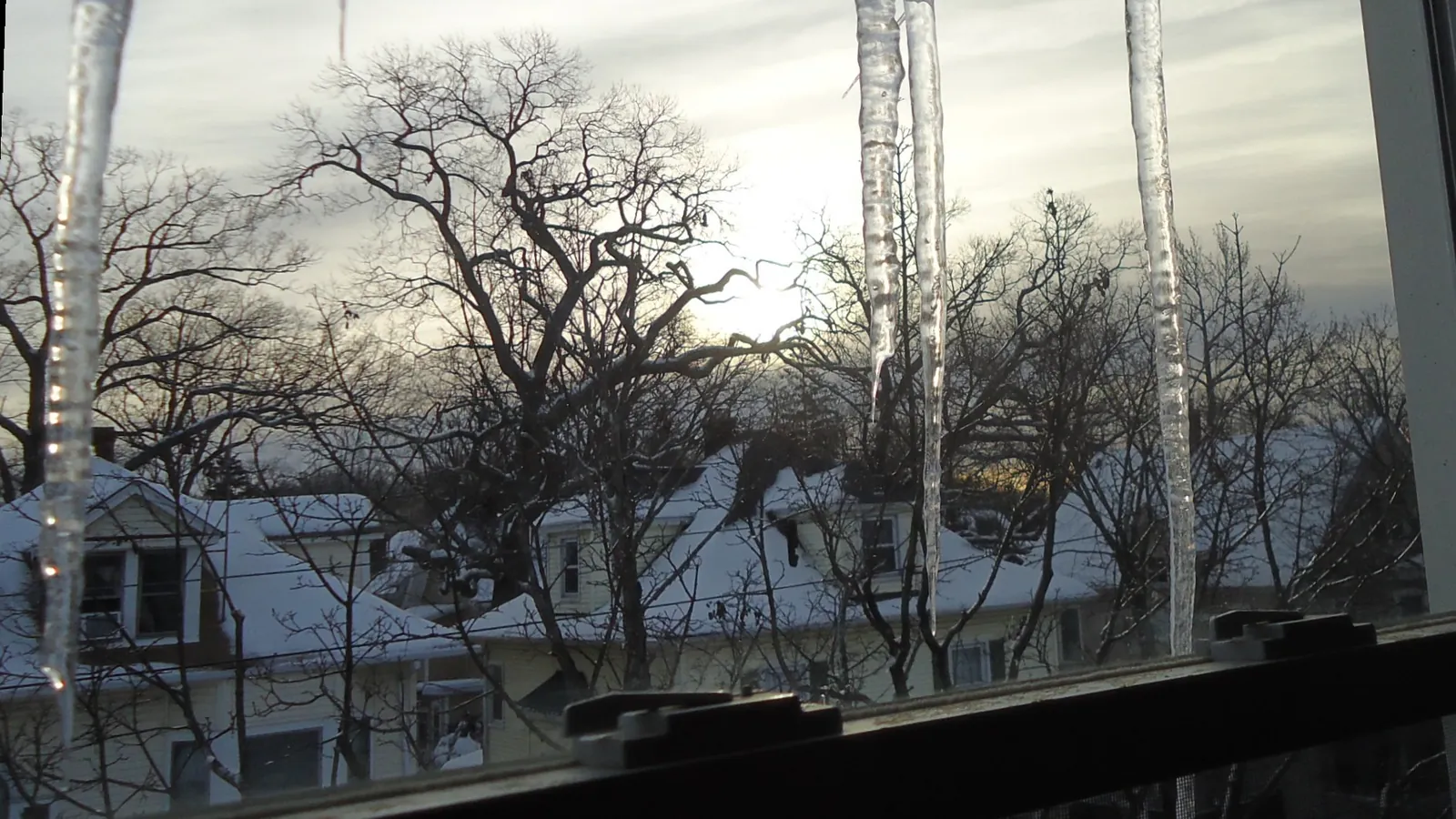
Why box gutters come up so often here
Essex County's housing is old. The Census Bureau's 2020 to 2024 estimates put 29% of the county's homes in buildings finished before 1940. New Jersey as a whole is at 17% and the country at 12%. In the towns along the Watchung ridge it is more than half. Those are the houses with slate, built-in box gutters and ornate cornices.
| Town | Built 1939 or earlier |
|---|---|
| Glen Ridge | 81% |
| Montclair | 59% |
| Maplewood | 56% |
| South Orange | 44% |
| Bloomfield | 38% |
| Orange | 28% |
| West Orange | 25% |
| Essex County as a whole | 29% |
In Orange, R&E's home town, about 52% of homes were built before 1960. About a quarter are two- to four-family houses with shared roofs and long gutter runs. See our Orange roofing page for the city's housing numbers.
Sources, read October 17, 2026: Census Bureau, American Community Survey 2020-2024 five-year estimates, table DP04, for Essex County and each town linked in the table (town figures as read September 22, 2026; the New Jersey and United States shares are 17.4% and 11.7% from the same table).
Self-Regulating or Constant-Wattage Cable
Two kinds of cable are sold for roofs and gutters. The choice changes both the price and the electric bill.
| Question | Self-regulating | Constant-wattage |
|---|---|---|
| How it heats | Draws more power as it gets colder and less as it warms, along every foot of its length (HomeAdvisor; Radiant Solutions: 6 W/ft at 50°F, 9.6 W/ft at 32°F). | Steady heat whenever it is switched on, at any temperature (HomeAdvisor). |
| Cable price per foot | $2 to $5 (HomeAdvisor) | $1 to $3 (HomeAdvisor) |
| Control | Can run on a thermostat or temperature switch; some makers sell a switch that turns on at 37°F and off at 50°F (Radiant Solutions). | Must be turned on and off by hand or by a thermostat (HomeAdvisor). |
| Can it be overlapped? | Yes; one maker says its cable can be overlapped during installation (Radiant Solutions). | Sold in fixed lengths; crossing the cable over itself is a listed fire risk in the makers' instructions. |
Essex County winters swing from cold snap to thaw every few days. For that pattern, self-regulating cable on a temperature switch costs the least to run. The constant-wattage kit is cheaper in the box.
Sources, read October 17, 2026: HomeAdvisor; Radiant Solutions; Edge Melt Systems; MasterShield, heated gutters guide (August 2026).
The Outlet, the Circuit and the Electrician
Heat cable is an electrical appliance that lives outside in the wet for four months. The makers' instructions are strict about how it is powered. The power is the part of the job that belongs to a licensed electrician, not a roofer. From one maker's published requirements (Radiant Solutions, read October 17, 2026):
- The outlet should be a properly wired GFCI outlet. That is the ground-fault type that trips when current leaks to ground.
- A dedicated circuit is recommended. Anything else on the circuit can trip the breaker. Then the cable is off during the storm it was bought for.
- No extension cords. They can overheat. The cable plugs straight into the outlet. So the outlet has to be near the eave.
- Circuit limits: no more than 113 feet of this maker's cable on a 15-amp circuit, or 150 feet on a 20-amp circuit. A long roof may need two circuits.
- A new outlet or circuit should be installed by a licensed electrician, in the maker's own words.
MasterShield's guide makes the same point from the other side. The problems it sees come from cable that is not on GFCI protection, not rated for outdoor exposure, or not secured properly. It calls that an installation-quality issue, not a flaw in the cable. HomeAdvisor lists fire hazard from incorrect installation among the downsides of heat tape.
How that splits the work: R&E Roofing installs the cable on the roof and in the gutters as part of its ice dam prevention and repair work. The outdoor GFCI outlet or the hardwired circuit is a licensed electrician's job. The quote should say who is doing it and what it costs.
Sources, read October 17, 2026: Radiant Solutions, electrical requirements and recommendations; MasterShield; HomeAdvisor.
When Heat Cable Is Worth It, and When It Is Not
The sellers of gutter guards say heat cable does not work. The sellers of heat cable say it does. Both are half right. The half that matters is where the ice forms. An ice dam starts on the roof above the outside wall. Heat escaping from the attic melts snow there, and it refreezes at the cold eave. LeafFilter (updated June 2026) calls heated gutters "extremely ineffective" against ice dams in cold, snowy climates. Its reason: the cable only melts a small tunnel around itself. MasterShield (August 2026) says the same thing more carefully. Gutter cable keeps the gutter and downspout clear. The dam forms higher up, where the cable does not reach. HomeAdvisor says to improve insulation and ventilation first. When that is not enough, heat tape becomes a practical solution.
That is also our view. Our ice dam prevention guide puts the attic first: air sealing, insulation and balanced attic ventilation. Cable is for the eave that still ices after that. Here is how we call it on a typical visit.
| What we find | What we recommend |
|---|---|
| One north-facing eave or shaded valley ices up every winter, and the attic has already been air-sealed and insulated | Cable makes sense. It keeps a drain channel open where the fix above has run out. |
| Icicles and a dam along most of the roof edge, warm attic, bare spots melting on the roof after a snowfall | Fix the attic first: air sealing, insulation and balanced soffit-to-ridge ventilation. Cable alone treats the symptom. |
| Gutters freeze solid and overflow, but no dam forms on the roof | Gutter and downspout cable, plus a fall cleaning. No roof zigzag needed. |
| A pre-1940 house with built-in box gutters that freeze and leak into the cornice | Cable in the box gutter and its outlets is often the practical answer, since rebuilding a box gutter costs far more. |
| A roof that is due for replacement in the next year or two | Hold off. Ice and water shield at the eaves goes on with the new roof, and cable can be added afterwards if still needed. |
| No outdoor outlet near the eave | Budget for a licensed electrician to add a GFCI outlet or a dedicated circuit before pricing the cable. |
The money comparison: HomeAdvisor puts insulation or ventilation work at $1,400 to $6,300. It puts a cable job at $900 to $1,800. The attic work costs more once and then costs nothing to run. The cable costs less once. Then it costs electricity every winter, plus a new cable in several years. Our attic insulation cost guide covers the New Jersey side of that first number.
Sources, read October 17, 2026: LeafFilter, the issue with gutter heaters; MasterShield; HomeAdvisor.
When to Book: Before Newark's December Freeze
The cable has to be on the roof before the snow is. Newark Liberty International Airport is the closest long-record weather station to Essex County. Its 1991-2020 normals put the average overnight low at 39.0°F in November and 31.2°F in December. It is 25.5°F in January and 27.2°F in February. December is the first month the average night is below freezing. January and February are when the ice dams form.
- October and November: the time to book. The gutters get cleaned, the attic gets looked at, and the cable goes on dry shingles. One maker lists a minimum installation temperature of 5°F for its cable. A cold day is not the problem. Snow on the roof is.
- December: still workable between storms. Searches for heated gutters in New Jersey jump this month.
- January and February: the dam is already there. Removal comes first; see our ice dam removal cost guide. Cable goes on after the roof is clear.
Sources, read October 17, 2026: NOAA National Centers for Environmental Information, U.S. Climate Normals 1991-2020, monthly, Newark Liberty International Airport (station USW00014734); Radiant Solutions, cable specifications.
What a Written Heat Cable Quote Should List
Two quotes that differ by a thousand dollars usually cover different things. Ask each contractor to put these in writing:
- The feet of cable, split into roof zigzag, gutter, downspout and valley runs. Which eaves each run covers.
- The cable make and type: self-regulating or constant-wattage. Watts per foot. Whether it is listed for roof and gutter use.
- The clips and how they attach, so the shingles are not nailed through.
- The control: a plug, a temperature switch or a thermostat. Who sets it.
- The power: which outlet or circuit it uses. Whether a new GFCI outlet or dedicated circuit is needed. Who the licensed electrician is.
- Any permit the town requires and who files it.
- What was found in the attic and the vents. Whether insulation, air sealing or ventilation was recommended instead of the cable, or as well as it.
- The maker's warranty on the cable. The contractor's own terms for the installation. Both in writing.
Replacing the gutters at the same time? Cable can be run in new seamless gutters as they go up. See our gutter installation service.
Questions Homeowners Ask About Heated Gutters and Heat Cable
Are heated gutters worth it?
For some eaves, yes. Heat cable keeps a channel open through the ice. Meltwater drains instead of backing up. That protects the gutter, the fascia and the wall below. It does not stop the dam from forming. Ice dams start higher up the roof, where attic heat melts snow unevenly. Gutter cable does not reach that zone (MasterShield, August 2026; LeafFilter, June 2026). HomeAdvisor says the same: fix insulation and ventilation first. When that is not enough, heat tape becomes practical. So cable is worth it for a north-facing eave or shaded valley that ices every year. It is not a substitute for insulation.
How much does a heated gutter system cost?
HomeAdvisor (updated June 19, 2026) puts heated gutters at $475 to $4,000. It puts a roof heating cable job at $900 to $1,800, with a $1,400 average. Small jobs run about $500 and large ones up to $4,600. GutterBrush (October 2024) prices the cable at $10 to $25 a foot. It puts professional installation at $500 to $2,000. These are national published figures, not R&E Roofing's prices. The price depends on the feet of roof edge, gutter and downspout covered. It also depends on whether a GFCI outlet or new circuit is needed, and on the cable type.
What are heated gutters, and do they really exist?
Yes. A heated gutter is an ordinary gutter with an electric heating cable in it. The cable runs along the bottom and down the downspout. Some systems put it under a heated gutter guard or an aluminum panel. Some add a second run in a zigzag along the roof edge. The cable warms the ice next to it enough to melt a channel. Water drains instead of backing up behind a dam. No gutter heats itself. The heat always comes from a cable on a GFCI outlet or its own circuit.
How do you keep gutters from freezing in the winter?
Three things, in this order. First, clean the gutters in late fall. A gutter full of leaves holds water and freezes solid. Second, slow the melting from above. Air-seal and insulate the attic floor. Keep soffit and ridge vents clear so the roof deck stays cold. Third, on eaves that still ice up every year, add self-regulating heat cable. Run it in the gutter and down the downspout. If the dam forms on the roof edge, add a zigzag along the eave. After a heavy snow, rake the lower roof from the ground.
How much does it cost to install heat tape on a roof?
Heat tape and heat cable are the same thing. HomeAdvisor (updated June 19, 2026) gives $900 to $1,800 for a roof heating cable job. Self-regulating cable is $2 to $5 a foot. Constant-wattage cable is $1 to $3. Labor is $30 to $90 an hour, or 15% to 35% of the bill. A permit, where the town requires one, adds $250 to $900 in HomeAdvisor's figures. One maker's plug-in self-regulating cable starts at $78.95 for its shortest length (October 2026 list). Every figure here is a published range, not an R&E Roofing quote.
Where can heating cables be installed?
On a shingle roof, in a zigzag along the lower two to three feet. It is clipped to the shingles, with the peaks past the line of the outside wall. In the gutter, along the bottom of the trough. Down every downspout, to below where the water leaves. In roof valleys and around dormers and skylights, where meltwater collects. In the built-in box gutters of pre-1940 houses. Essex County has many of those: 29% of the county's homes were built before 1940 (Census ACS 2020-2024). In Glen Ridge, Montclair and Maplewood it is more than half. Heat cable is never laid under shingles or inside walls.
How hot do roof heat cables get?
Warm, not hot. One maker lists an average cable temperature of 40°F to 100°F in normal operation. Its output is 6 watts a foot at 50°F and 9.6 watts a foot at 32°F (Radiant Solutions, read October 2026). That is enough to keep a melt channel open next to the cable. It is not enough to melt a whole roof of snow. It will not scorch shingles when installed with the maker's clips. Constant-wattage cable gives the same heat at every temperature. It has to be switched off by hand or by a thermostat.
Can you put heat cables in gutters?
Yes. The gutter and downspout are usually the first place the cable goes. A run along the gutter bottom keeps a channel open, so water that reaches the gutter can leave. A run down the downspout stops the plug of ice at the bottom. The limit: gutter-only cable melts a narrow tunnel around itself. Ice can still build on either side of it. It does nothing for a dam on the roof above the gutter (MasterShield, August 2026). If the dam is on the roof, the cable has to go on the roof too.
Do heated gutters use a lot of electricity?
It depends on the length of cable and the hours it runs. Here is a worked example. PSE&G's residential price to compare is about 19.8 cents a kilowatt-hour: an energy charge of $0.129120 plus a transmission charge of $0.068806 (winter rates, including sales tax, effective October 1, 2026). One hundred feet of self-regulating cable draws 960 watts at 32°F. Around the clock, that is 23 kilowatt-hours a day. That is about $4.56 a day, or about $137 for a 30-day cold month. On a thermostat that runs it about 8 hours a day, the same run is about $46 a month. PSE&G's distribution charges come on top, so the real bill is higher. Published national estimates run $10 to $50 a month (GutterBrush) and $40 to $200 or more (HomeAdvisor); our around-the-clock figure sits inside HomeAdvisor's range.
How long do gutter heat cables last?
Several winters, when the cable is rated for outdoor use and installed properly on GFCI power (MasterShield, August 2026). HomeAdvisor says lifespans vary by product and usage. Cable left in an open gutter under leaves and standing water wears faster. Two makers back their cable with a 10-year warranty (Radiant Solutions; Edge Melt Systems). Check the cable, clips and plug each fall before the first freeze. Replace any run with a cracked jacket.
Do I need an electrician for roof heat cable?
For the outlet or circuit, yes. The cable plugs into a properly wired outdoor GFCI outlet, or is hardwired to its own circuit. One maker recommends a dedicated circuit and says never to use an extension cord. It limits a 15-amp circuit to 113 feet of its cable and a 20-amp circuit to 150 feet. It says a new outlet or circuit should be installed by a licensed electrician (Radiant Solutions, read October 2026). R&E Roofing installs the cable on the roof and in the gutters as part of its ice dam work. The outlet and any new circuit are the electrician's part of the job.