New Jersey cost guide · Essex County homes
Synthetic Slate Roof Cost in New Jersey (2026): Installed Prices, Product Types, Weight and Ratings
Short answer: synthetic slate runs $9 to $12 per square foot installed (HomeGuide, November 2025), or $10 to $15 (Angi, September 2026). Written for Essex County owners of slate-roofed and older homes in Montclair, Glen Ridge, South Orange, Maplewood, West Orange and Newark's historic neighborhoods.
Synthetic Slate Prices at a Glance
- Installed: $9 to $12 per sq ft, or $12,500 to $26,000 for a typical roof (HomeGuide, November 2025); $10 to $15 per sq ft (Angi, September 2026).
- Materials only: $300 to $1,200 per square of 100 sq ft, depending on the brand and style (HomeGuide).
- Natural slate, for comparison: $15 to $30 per sq ft (Angi), or $1,000 to $3,000 per square installed (HomeGuide).
- Weight: about 260 to 350 lb per square for the synthetic products compared here, against about 935 lb for quarter-inch natural slate.
- Lifespan: 30 to 50 years for synthetic (HomeGuide); 60 to 125 years or longer for natural slate (National Park Service).
Every price on this page is a published figure quoted from the named source with its date. None of them is R&E Roofing's price. Brand names are third-party examples, not products R&E Roofing represents.
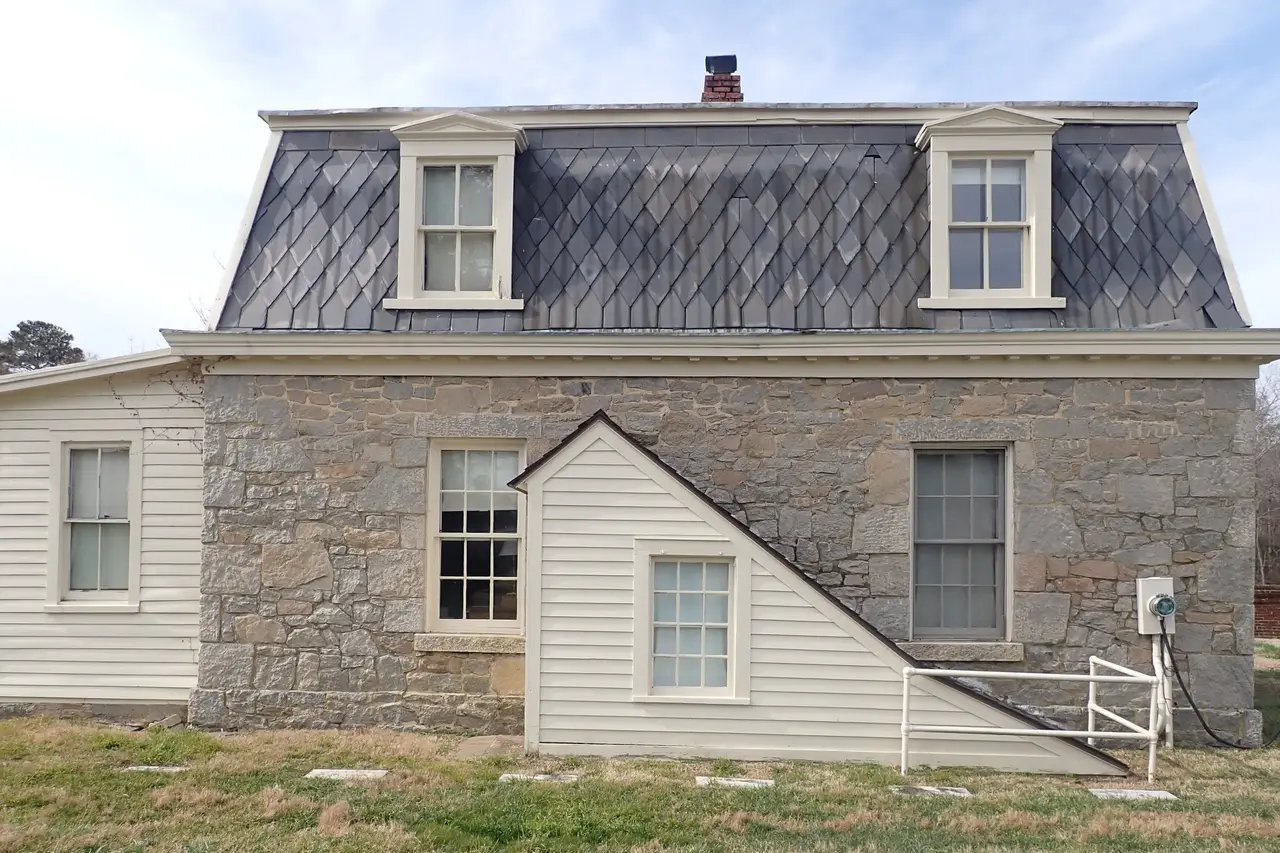
A synthetic slate roof usually costs $9 to $15 per square foot installed, going by HomeGuide ($9 to $12) and Angi ($10 to $15): roughly half the price of natural slate, at about a third of the weight.
“Synthetic slate” is a family of products, not one material: molded polymer tiles, recycled rubber and plastic tiles, and asphalt shingles cut to look like slate all go by the name, and they differ in price, weight, fire rating and how convincing they look from the street. This guide puts the published prices side by side, sorts the products by type using the makers' own documents, and covers the two questions Essex County owners ask most: can the house carry real slate, and will the historic district accept a substitute. For natural slate, our slate roof installation guide and slate repair and restoration guide cover that work, and our slate roofing page lists what R&E Roofing does.
Synthetic Slate Prices, Source by Source
Five published figures, each with what it covers. Installed prices run from $6 to $15 per square foot; the material alone runs from $300 to $1,200 per square.
Synthetic slate prices as published. None is an R&E Roofing price.
| Source | Published price and what it covers |
|---|---|
| HomeGuide (Nov 7, 2025) | $9 to $12 per sq ft installed; $12,500 to $26,000 for a typical roof |
| Angi (Sep 15, 2026) | $10 to $15 per sq ft, given among installation costs |
| Trust Roofing (Apr 8, 2024) | $6 to $12 per sq ft, materials and installation |
| HomeGuide (Nov 7, 2025), materials | $300 to $1,200 per square ($3 to $12 per sq ft), materials only |
| HomeAdvisor (May 30, 2024) | $400 to $1,200 per square for plastic polymer shingles, materials only |
HomeGuide also prices the material by brand, per square of 100 square feet, before labor. It says installation labor is about 50% of the total.
Synthetic slate material by brand, per square, from HomeGuide (November 2025). Not an R&E Roofing price.
| Brand | Per square | Material |
|---|---|---|
| Brava | $700 to $1,150 | Composite plastic/polymer |
| DaVinci | $400 to $1,200 | Composite resin/polymer |
| EcoStar | $300 to $800 | Composite plastic/polymer or rubber |
That is why the installed range is as wide as it is: the brand and style chosen move the material price from $300 to $1,200 per square, a factor of four, before labor is added.
Sources, read November 16, 2026: HomeGuide, synthetic slate roofing cost (November 7, 2025); Angi, slate roof installation cost (September 15, 2026); Trust Roofing (April 8, 2024); HomeAdvisor, roofing material prices (May 30, 2024).
Synthetic vs Natural Slate: Price, Weight, Lifespan
Synthetic and natural slate compared, from the sources named in each cell. Not R&E Roofing figures.Swipe the table sideways to see every column.
| Synthetic slate | Natural slate | |
|---|---|---|
| Installed price | $9 to $12 per sq ft (HomeGuide); $10 to $15 (Angi) | $1,000 to $3,000 per square (HomeGuide); $15 to $30 per sq ft (Angi) |
| Weight per square (100 sq ft) | About 260 to 350 lb (makers' figures below) | About 935 lb for 1/4-inch slate (National Slate Association) |
| Lifespan | 30 to 50 years (HomeGuide) | 60 to 125 years or longer (National Park Service) |
Over time the gap narrows. A natural slate roof that lasts 60 to 125 years can outlive two synthetic roofs at HomeGuide's 30 to 50 years. The case for synthetic is strongest where the framing was never built for slate, where the budget does not stretch to stone, or where the existing slate is past saving and the district allows a substitute. Where the existing slate is sound, repair usually beats both; our slate repair guide explains when.
Sources, read November 16, 2026: HomeGuide; Angi; National Slate Association; National Park Service, Preservation Brief 29.
What Synthetic Slate Is Made Of
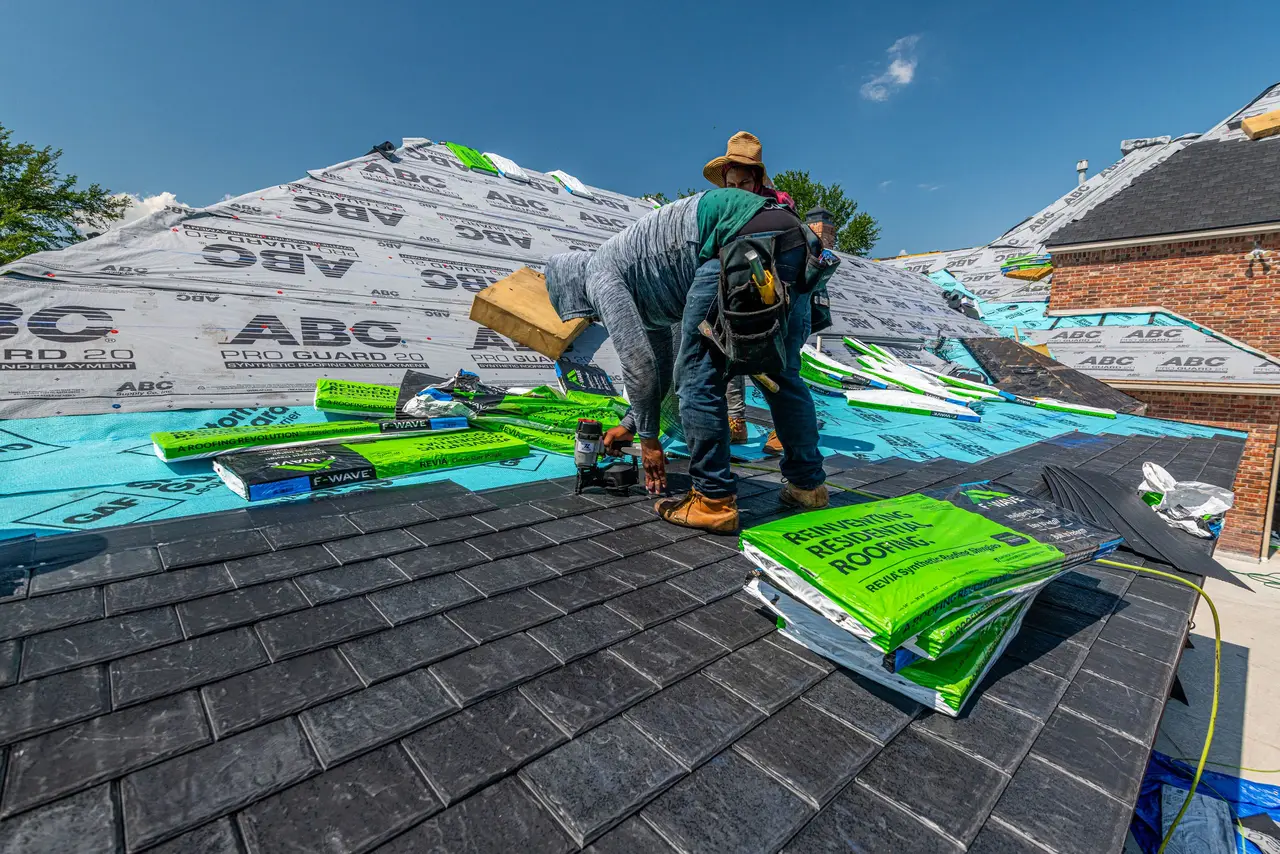
The table sorts four products by type, using each maker's own product page, tech sheet or sell sheet. They are examples to show how the types differ, not a recommendation. Weights are per square of 100 square feet.
Synthetic and slate-look products by type, from the makers' documents read November 16, 2026.Swipe the table sideways to see every column.
| Type | Example | Made of | Fire | Impact | Weight per square |
|---|---|---|---|---|---|
| Polymer composite of virgin resin | DaVinci Single-Width Slate | Pure virgin resins with UV and thermal stabilizers and a fire retardant | Class A (with the underlayment listed in the maker's code reference) | Class 4 | 260.7 lb at 8-inch exposure; 347.6 lb at 6-inch |
| Recycled rubber and plastic | EcoStar Traditional Slate | Recycled rubber and plastics, up to 80% post-industrial recycled content | Class C or A (UL 790), by version | Class 4 (UL 2218) | 275 lb (Class C version) or 308 lb (Class A version), at maximum reveal |
| Composite polymer | Brava Old World Slate | Composite plastic/polymer (HomeGuide) | Class A with fire-retardant underlayment; Class C with standard underlayment | Class 4 | 311 lb |
| Slate-look asphalt shingle | GAF Slateline | Designer asphalt shingle | Class A (UL 790) | Class 4 (UL 2218) | Not compared here |
- Molded polymer and composite tiles are individual pieces, molded to the size and edge of a slate and nailed one by one, much like natural slate.
- Recycled rubber and plastic tiles are the same idea made largely from recycled material; EcoStar says up to 80% post-industrial recycled content.
- Slate-look asphalt shingles are asphalt shingles cut and colored to suggest slate. In a historic district that compares thickness and texture with the original (section 6), ask how the product compares before choosing it.
- Fiber cement is a fourth type: the National Park Service's Preservation Brief 16 lists fiber cement and mineral/polymer composite among the potential substitutes for historic roofing materials, slate shingle among them.
Sources, read November 16, 2026: DaVinci product page; DaVinci tech sheet (effective September 29, 2025); DaVinci codes quick reference; EcoStar product page; EcoStar sell sheet; Brava product page; HomeGuide; GAF Slateline product page; National Park Service, Preservation Brief 16 (2023).
Fire and Impact Ratings, and the Underlayment Catch
Two ratings appear on all four product pages compared here:
- Fire (UL 790). The makers list Class A or Class C. The catch is that the class can depend on what is bought with the product: Brava passes Class A when tested with fire-retardant underlayment and Class C with standard underlayment; EcoStar sells separate Class C and Class A versions; DaVinci's code reference lists specific underlayment layers, such as one layer of 30-pound ASTM D226 felt, for its Class A system. A quote that says “Class A” should name the underlayment that makes it so.
- Impact (UL 2218). All four products in the table list Class 4. The test strikes the roof covering with steel balls, and IBHS notes the Class 4 ball is the largest, 2.00 inches in diameter, against 1.25 inches for Class 1.
EcoStar also lists wind resistance under ASTM D3161, Class F, and GAF lists the same class for Slateline. Ask for the rating sheet of the exact product line in your quote, because ratings vary within a brand.
Sources, read November 16, 2026: Brava; EcoStar; DaVinci codes quick reference; GAF; IBHS.
Weight, Older Essex County Houses and Permits
In Essex County, 29.1% of homes were built in 1939 or earlier, against 11.7% across the United States (U.S. Census Bureau, American Community Survey 2020-2024). On a house that old, whether the framing can carry natural slate is a real question, and the weight gap below is why.
- Natural slate is heavy. The National Slate Association puts quarter-inch slate at about 935 pounds per square, or 9.35 pounds per square foot, and half-inch slate at about 18.70 pounds per square foot.
- Synthetic slate is not. The products above weigh 260.7 to 347.6 pounds per square (DaVinci, by exposure), 275 or 308 (EcoStar) and 311 (Brava): roughly a quarter to a third of quarter-inch natural slate.
- Why it matters for permits. New Jersey's code lists “the repair or replacement of existing roof covering on detached one- and two-family dwellings” as ordinary maintenance (N.J.A.C. 5:23-2.7(c)1.x), which needs no permit. But ordinary maintenance never includes “any work affecting structural or fire safety.” Putting natural slate on framing that was not built for it can mean reinforcing the rafters, which is structural work for the construction office. A lighter synthetic usually goes on the existing framing.
Sources, read November 16, 2026: U.S. Census Bureau, ACS 2020-2024, DP04, Essex County, NJ; same table, United States; National Slate Association; DaVinci tech sheet; EcoStar sell sheet; Brava; N.J.A.C. 5:23-2.7 (current through N.J.R. August 17, 2026).
Historic Districts and Substitute Slate
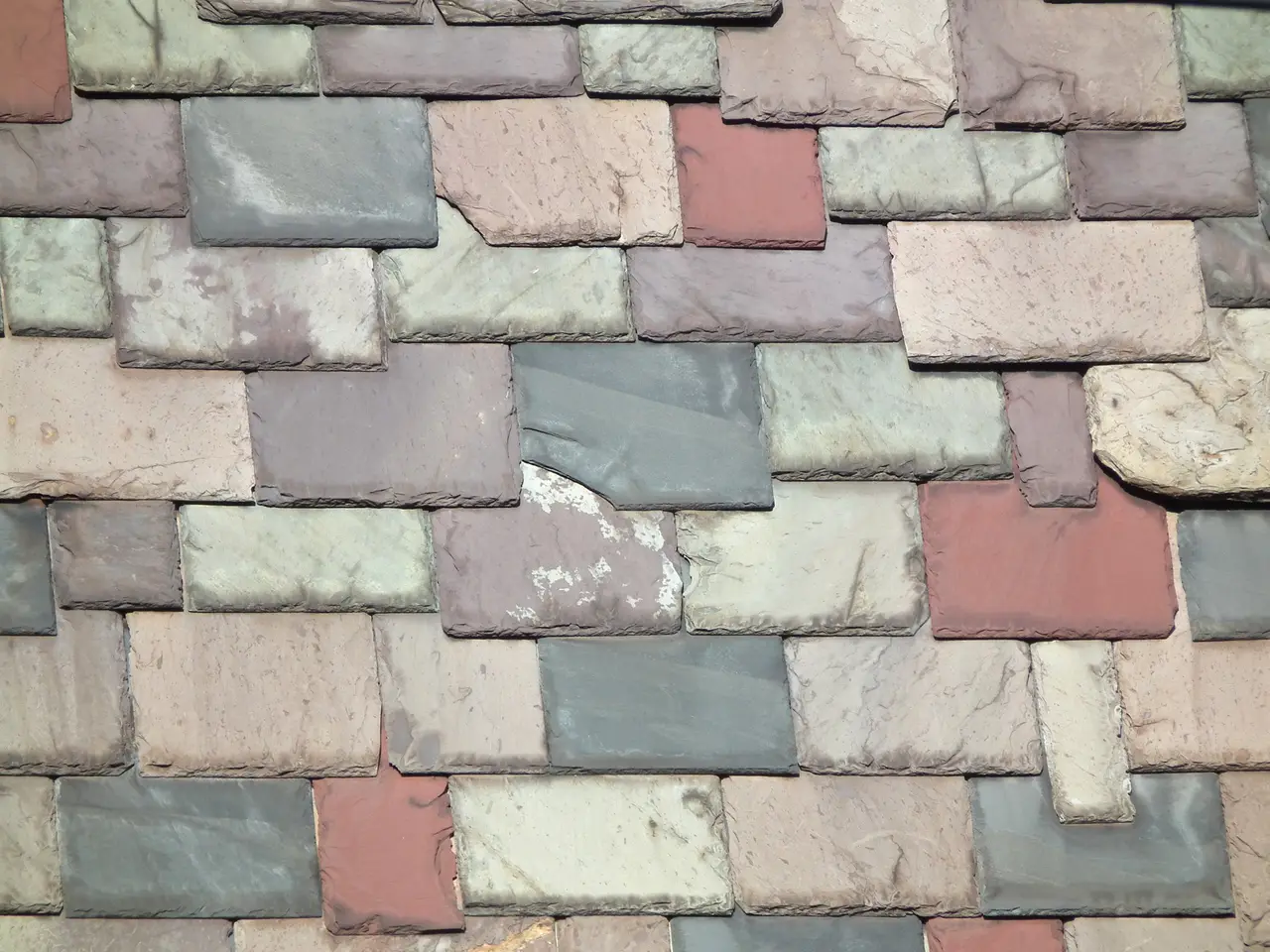
Montclair, Maplewood, South Orange and Newark each have a local historic preservation commission, and a slate roof in a local district is exactly what they review. Montclair's residential historic design guidelines are the most direct:
- “A change of roofing material requires HPC review.”
- Do: “Use materials originally on the building or alternates with similar texture, scale, reflectance, color and thickness.”
- Do: “Select a roofing material by placing a minimum 3 square foot sample on the roof in daylight.”
- Don't: “Using imitation materials with grain, color, thickness or sheen different from the original.”
The National Park Service sets the national standard these commissions draw on. Preservation Brief 29 says slate roofs “are a critical design feature of many historic buildings that cannot be duplicated using substitute materials,” and that too often they are “improperly repaired or replaced with alternative roofing materials.” Preservation Brief 16, revised in 2023, lists fiber cement and mineral/polymer composite among the potential substitutes for historic roofing materials, slate shingle among them. Plan for the commission to ask whether the existing slate can be repaired, and, if replacement is approved, to compare any substitute with the original in texture, thickness, size and color, which is the test in Montclair's guidelines above.
The rules in Maplewood, South Orange and Newark are explained on our Maplewood, South Orange and Newark roofing pages. Anywhere else, ask the town whether your street is in a local historic district before choosing a product.
Sources, read November 16, 2026: Montclair Residential Historic Design Guidelines (October 13, 2022); National Park Service, Preservation Brief 29; National Park Service, Preservation Brief 16 (2023).
What a Synthetic Slate Quote Should Spell Out
- The maker, product line and color blend, by name.
- The product type: molded tile or slate-look shingle.
- The exposure (6 or 8 inches, for example), which changes the weight and the tile count.
- The fire class and the underlayment that achieves it.
- Hip, ridge and starter pieces, and whether they are the maker's own.
- Flashing metal at valleys, chimneys and walls.
- Tear-off of the old roof, disposal and any decking repair.
- Whether a framing check or a historic commission review is needed, and who handles it.
- What the maker's warranty covers, and whether it depends on installation details.
Before hiring anyone, check the contractor's state registration; our guide to the New Jersey contractor lookup shows how. For how synthetic slate compares with metal, shingles and cedar in New Jersey weather, see our roofing materials guide.
Questions Homeowners Ask About Synthetic Slate Cost
How much does a synthetic slate roof cost?
HomeGuide puts synthetic slate at $9 to $12 per square foot installed, or $12,500 to $26,000 for a typical roof (November 2025). Angi puts it at $10 to $15 per square foot (September 2026). These are national figures, not R&E Roofing's price; the product, the roof's size and pitch, and tear-off decide the real number.
Is synthetic slate cheaper than real slate?
Yes. At the middle of the published ranges, synthetic slate costs a little over half as much as natural slate. Angi puts natural slate at $15 to $30 per square foot against $10 to $15 for synthetic, and HomeGuide puts natural slate at $1,000 to $3,000 per square installed against $9 to $12 per square foot ($900 to $1,200 per square) for synthetic. Natural slate lasts much longer, which narrows the gap over time.
How much does synthetic slate weigh?
The makers' figures run from about 260 pounds per square for DaVinci Single-Width Slate at an 8-inch exposure to 347.6 at a 6-inch exposure, with EcoStar at 275 or 308 and Brava at 311. The National Slate Association puts quarter-inch natural slate at about 935 pounds per square, so synthetic slate weighs roughly a quarter to a third as much.
How long does synthetic slate last?
HomeGuide says 30 to 50 years, depending on whether it is made from plastic or rubber. A maker's warranty term is not a lifespan; read what the warranty covers and for how long. Natural slate lasts 60 to 125 years or longer, according to the National Park Service.
Is synthetic slate fire rated?
Each product compared here has a Class A option, but for some it depends on the underlayment or the version bought. Brava passes Class A when tested with fire-retardant underlayment and Class C with standard underlayment; EcoStar sells Class C and Class A versions; DaVinci's code reference lists the underlayment layers for its Class A system. Ask which underlayment the quote includes.
Will my historic district allow synthetic slate?
Ask before you choose. In Montclair, a change of roofing material requires the Historic Preservation Commission's review, and the township's guidelines list using imitation materials with grain, color, thickness or sheen different from the original as something to avoid. The National Park Service says historic slate roofs cannot be duplicated using substitute materials and should be maintained and repaired where possible.
Do I need a permit for a synthetic slate roof in New Jersey?
New Jersey's code lists the repair or replacement of existing roof covering on detached one- and two-family dwellings as ordinary maintenance, which needs no permit (N.J.A.C. 5:23-2.7). Work affecting structural safety is not ordinary maintenance, so framing changes need the construction office. A historic district review is separate from the permit.
Does R&E Roofing install synthetic slate?
Synthetic slate alternatives are on the scope list of our slate roofing page, alongside natural slate work. We look at the roof and the framing, talk through natural and synthetic options, and give a written estimate; call (667) 204-1609 or use our quote request form.
Sources
Every source below was read on November 16, 2026. Prices are national published figures, not R&E Roofing prices.
- HomeGuide, How Much Does Synthetic Slate Roofing Cost? (November 7, 2025)
- Angi, How Much Does Slate Roof Installation Cost? (updated September 15, 2026)
- HomeAdvisor, Roofing Material Prices (updated May 30, 2024)
- Trust Roofing, 5 Best Synthetic Slate Roof Tiles to Consider in 2024 (April 8, 2024)
- Westlake Royal Building Products, DaVinci Single-Width Slate product page
- DaVinci tech sheet (effective September 29, 2025)
- DaVinci codes quick reference (updated February 2020)
- EcoStar, Traditional Slate product page
- EcoStar, Traditional Slate sell sheet
- Brava Roof Tile, Old World Slate product page
- GAF, Slateline shingles product page
- Insurance Institute for Business & Home Safety, Relative Impact Resistance of Asphalt Shingles
- National Slate Association, Common Myths About Slate Roofing
- National Park Service, Preservation Brief 29: The Repair, Replacement, and Maintenance of Historic Slate Roofs
- National Park Service, Preservation Brief 16: The Use of Substitute Materials on Historic Building Exteriors (revised 2023)
- Township of Montclair, Residential Historic Design Guidelines (October 13, 2022)
- N.J.A.C. 5:23-2.7, Ordinary maintenance, New Jersey Department of Community Affairs (current through N.J.R. August 17, 2026)
- U.S. Census Bureau, American Community Survey 2020-2024 5-year, table DP04, Essex County, NJ
- Same table, United States