
Water Dripping From a Bathroom Fan? How to Tell Condensation From a Roof Leak, and Who Fixes Each
The Short Answer
- Usually condensation: shower air turns to water in a duct that crosses a cold attic, then runs back to the fan.
- Sometimes the roof: rain or snowmelt gets in at the vent cap, the boot or the flashing and follows the duct down.
- Test by timing: drips on cold, dry mornings or after showers point to condensation; drips during or after rain or snowmelt point to the roof.
- Who fixes it: a roofer fixes the cap, boot and flashing (R&E Roofing's part); an HVAC contractor or an electrician fixes the duct and the fan.
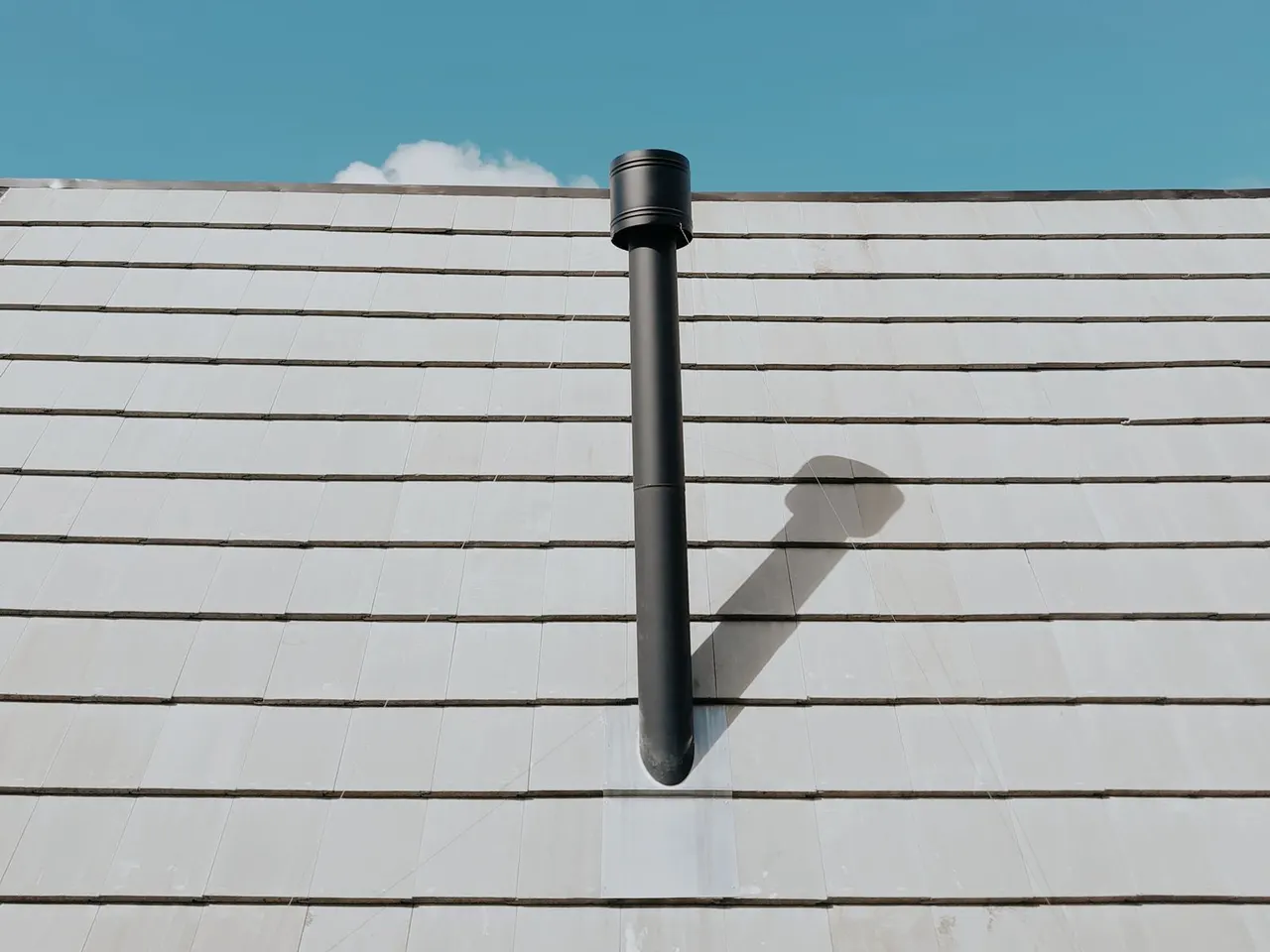
Water dripping from a bathroom fan has two possible sources, and they need two different repairs. One is moisture from your own shower. The other is weather getting in through the roof.
Most of the pages that rank for this question focus on condensation and say little about the roof. We are roofers, so this guide gives both causes equal time. It shows you how to tell them apart in a day or two, what New Jersey's code says about where a bath fan must vent, and who to call for each fix. If the water turns out to come from the roof, our roof vent boot repair page explains the repair. For the attic side of moisture, see our guide to attic condensation versus a roof leak.
Is a Little Water From the Fan Normal?
Some water inside the duct is normal in a New Jersey winter. Water on your floor is not. The numbers explain why the first part is hard to avoid:
- Indoor air condenses near freezing even when dry. Fine Homebuilding notes that 70°F air at 25% relative humidity condenses at 33°F. Shower air is far wetter than that.
- A shower makes real water. In the same answer, Michael Maines works out almost 3/4 cup of condensate from a 10-minute steamy shower with a 110 cfm fan when it is 25°F outside.
- Essex County attics get that cold. Newark's average January low is 25.5°F, and 22.6 January nights fall to 32°F or below (NOAA 1991-2020 normals, Newark Liberty International Airport).
So a duct that runs through a cold attic will collect moisture. A sound system keeps that moisture moving outside. When it runs back to the fan instead, something in the system needs fixing.
Sources, read November 16, 2026: Fine Homebuilding, “Venting a Bath Fan in a Cold Climate” (Michael Maines); NOAA NCEI, 1991-2020 monthly normals, Newark Liberty International Airport.
The Test: Condensation or Roof Leak?
You do not need tools to tell the two apart. You need a few days of notes about when the water shows up.
- Dry the grille and the ceiling around it. Put a towel or a small container under the fan.
- Write down each time you find water, with the time and the weather: dry and cold, raining, windy rain, snowing or thawing.
- Note whether someone showered in the hour before, and how long the fan ran.
- After two or three showers and one rain, compare your notes with the table below.
- If you can get into the attic safely, look at the duct and the underside of the roof around the vent with a flashlight.
What the timing and the attic tell you
| What you see | Points to |
|---|---|
| Drips on cold, dry mornings, or during and right after a shower | Condensation in the duct |
| Drips only during or after rain, wind-driven rain or snowmelt | Water entering at the roof cap, boot or flashing |
| Drips on the first mild or sunny day after a hard freeze | Either: frost in the duct thawing, or snowmelt at the cap |
| The outside of the duct is wet in the attic, or water sits in a sag | Condensation in the duct |
| Stained roof boards, rusty nails or daylight around the vent opening | Water entering at the roof |
The thaw trap. In a cold snap, moisture in the duct can freeze. Fine Homebuilding describes exterior vents icing up in cold weather. When that frost melts on the first mild day, it drips like a leak. If the drip came on a dry thaw with no snow on the roof, condensation is the better bet. If there was snow piled around the cap, check the roof.
Not sure after a week? Our guide on how to find a roof leak shows how to trace water in the attic back to where it enters.
Sources, read November 16, 2026: Home Ventilating Institute, FAQs; Fine Homebuilding.
Why Ducts Sweat in an Essex County Winter
Condensation forms wherever moist air meets a surface colder than its dew point. In a bath fan, that surface is the duct, or the metal fan housing itself. These are the usual reasons it gets cold enough to drip:
- A bare duct in a cold attic. The Home Ventilating Institute says the most common reason is uninsulated duct running through unconditioned space, and that insulated duct should correct it.
- The fan runs too briefly. The Institute recommends leaving the fan on for 20 minutes after the bathroom is used. A fan switched off with the light leaves wet air sitting in the duct.
- Cold air drifts back down the duct. Panasonic says drips happen mostly in the morning while the fan is off. Outdoor air can flow back through a horizontal or soffit run and chill the fan housing.
- A damper that does not close. Panasonic points out that a 6-inch duct has more than 28 square inches of opening, against about 12.5 for a 4-inch duct. A stuck damper on a big duct lets in a lot of cold air.
- A long, sagging or kinked duct. Slow air has more time to cool, and a sag holds water. The code's length limits are in the next section.
- A duct that ends in the attic. The wet air never leaves. It soaks the insulation and the roof boards, and it is not allowed under New Jersey's code.
Older houses deserve a closer look. In Essex County, 29.1% of homes were built in 1939 or earlier (U.S. Census Bureau, American Community Survey 2020-2024). InterNACHI puts a ceiling vent fan's life at 5 to 10 years. So the fan in a house that age has been replaced at least once, and its duct may have been routed by whoever was there that day. Check where it actually ends.
Sources, read November 16, 2026: Home Ventilating Institute, FAQs; Home Ventilating Institute, bathroom ventilation; Panasonic, “How to prevent dripping vent fans in cold weather” (Ken Nelson); U.S. Census Bureau, ACS 2020-2024 5-year, table DP04, Essex County, NJ; InterNACHI, Standard Estimated Life Expectancy Chart.
What New Jersey's Code Requires
New Jersey's rules for one- and two-family homes adopt the 2021 International Residential Code (N.J.A.C. 5:23-3.21(a)1). The state makes no changes to its exhaust chapter. These are the lines that matter for a dripping fan:
- Where the air must go (M1501.1). Exhaust air “shall be discharged to the outdoors.” It “shall not be exhausted into an attic, soffit, ridge vent or crawl space.”
- Bathrooms in particular (M1505.2). Bathroom exhaust “shall be exhausted directly to the outdoors” and may not discharge into an attic, crawl space or other areas inside the building.
- Where the outlet may sit (M1504.3). At least 3 feet from property lines, operable windows and doors, and 10 feet from a mechanical air intake unless it is 3 feet above it.
- How strong the fan must be (Table M1505.4.4). 50 cfm when run on demand, or 20 cfm when run continuously.
The code also caps duct length by fan size and duct type (Table M1504.2). A small fan cannot push air through a long, ribbed duct:
Maximum bath fan duct length, from 2021 IRC Table M1504.2 (fan rated at 0.25 inch water column; no elbows)
| Duct and fan | Longest run allowed |
|---|---|
| 4-inch flex duct, 50 cfm fan | 56 feet |
| 4-inch flex duct, 80 cfm fan | 4 feet |
| 4-inch smooth-wall duct, 50 cfm fan | 114 feet |
| 4-inch smooth-wall duct, 80 cfm fan | 31 feet |
| 3-inch flex duct, any fan | Not allowed |
| Each elbow in the run | Subtract 15 feet |
The table has an exception: length is not limited when the system follows the fan maker's design or the airflow is measured after installation.
About soffit vents. Some fan makers sell a dedicated soffit outlet, and Panasonic recommends one. The adopted code bars exhausting “into” a soffit. If you are thinking about a soffit outlet, ask your town's construction official before it goes in.
Permits. New Jersey lists replacing a bathroom exhaust fan in a home as ordinary maintenance, with no permit, “provided that the fan vents independently to the outdoors” (N.J.A.C. 5:23-2.7(c)5.ix). Repairing or replacing duct work and repairing roof covering on detached one- and two-family homes are on the same list. A fan that blows into the attic does not meet the condition, so ask the construction office before replacing it.
Sources, read November 16, 2026: N.J.A.C. 5:23-3.21, one- and two-family dwelling subcode; International Code Council, 2021 IRC Chapter 15; New Jersey edition of the same chapter (UpCodes); N.J.A.C. 5:23-2.7, New Jersey Department of Community Affairs (current through N.J.R. August 17, 2026); Panasonic.
When the Water Comes In at the Roof
A bath fan duct that vents through the roof ends at a cap, also called a roof jack or vent hood. The cap sits on a flange that is tucked under the shingles above it and laid over the shingles below it. Water gets in when any part of that chain fails:
- The cap itself. Plastic hoods can crack as they age. Animals chew through them, as in the photo below.
- The damper in the cap. A flap that is broken or stuck open lets wind push rain straight into the duct.
- The flashing and the shingle lap. If the flange sits on top of the shingles above it, or its nails have backed out, water runs under it.
- Sealant used as the repair. A bead of caulk around a cap ages and opens again.
- A nearby plumbing vent boot. Water from a cracked boot can run along the rafters and show up at the fan. Our roof vent boot repair page notes that a stain may be several feet from the pipe.
- Snow and ice around the cap. Meltwater that backs up behind ice can find the same gaps.
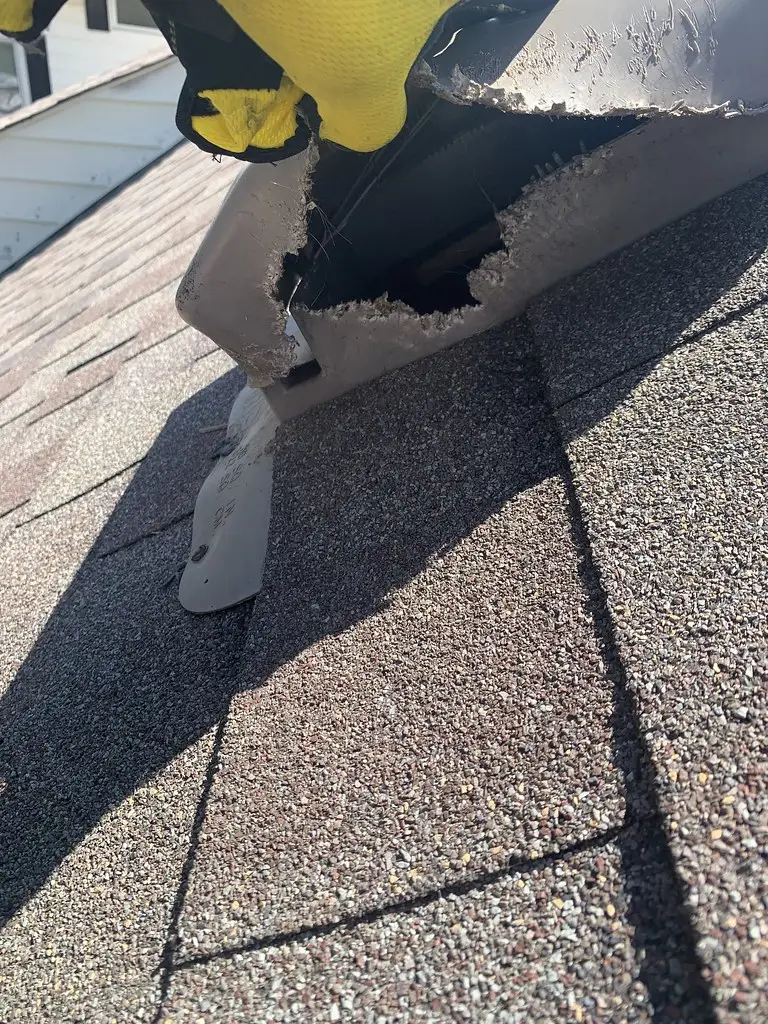
What R&E Roofing does here. This is our part of the job. We look at the cap, the boot or collar, the flashing and the shingles around the opening. Then we replace the failed part and lap the new one into the roof so water sheds over it, the way our roof vent boot repair page describes. Where the flashing is the problem, our roof flashing repair page covers it, and our roof flashing repair cost guide lists published prices from outside sources.
Source, read November 16, 2026: Home Ventilating Institute, FAQs (wind-driven rain through a faulty roof or wall jack).
Condensation Fixes, in Order
If your notes point to condensation, start with the simplest step and work down the list.
- Run the fan longer. Leave it on 20 minutes after a shower, as the Home Ventilating Institute recommends. A timer or humidity switch makes that automatic. Fine Homebuilding adds that starting the fan before the shower warms the duct first.
- Check the damper at the fan. Take off the grille and push the flap. Family Handyman says a damper that does not move freely may need replacing.
- Insulate the duct. Fine Homebuilding's best practice is R-3 to R-8 on the whole duct, or at least the last 6 feet before the outlet, where condensation is most likely.
- Shorten, straighten and support it. Remove sags and extra length, and keep within the code limits above. Smooth-wall duct carries air much farther than flex duct.
- Send it outside. A duct that ends in the attic, a soffit cavity or a ridge vent needs its own outlet through the roof or a wall.
- Check the fan size. The Institute recommends 1 cfm per square foot of floor for bathrooms up to 100 square feet, about eight air changes an hour.
Keep the house drier overall, too. The EPA recommends indoor humidity below 60%, ideally between 30% and 50%. A hygrometer costs little and tells you where you stand.
Moisture that never leaves the attic causes more than drips. Our roof ventilation guide for New Jersey explains how attic airflow and bath fan ducts work together, and our attic ventilation page covers the roof vents that let an attic dry out.
Sources, read November 16, 2026: Home Ventilating Institute, bathroom ventilation; Fine Homebuilding; Family Handyman, “Why Is Water Dripping from My Bathroom Fan?” (Chris Deziel, February 16, 2024); U.S. EPA, A Brief Guide to Mold, Moisture and Your Home.
Who Fixes What
A dripping fan sits where three trades meet. Calling the right one first saves a wasted visit.
The usual trade for each cause
| Problem | Who usually fixes it |
|---|---|
| Roof cap or hood cracked, chewed, loose or missing its damper | Roofer |
| Boot, collar or flashing around the duct failed, or shingles lapped wrong | Roofer |
| New roof opening for a duct that now ends in the attic | Roofer cuts and flashes the opening; the duct is connected to it |
| Duct uninsulated, sagging, too long or disconnected | Usually an HVAC or insulation contractor |
| Fan too weak, damper stuck at the fan, new timer or humidity switch | Usually an electrician |
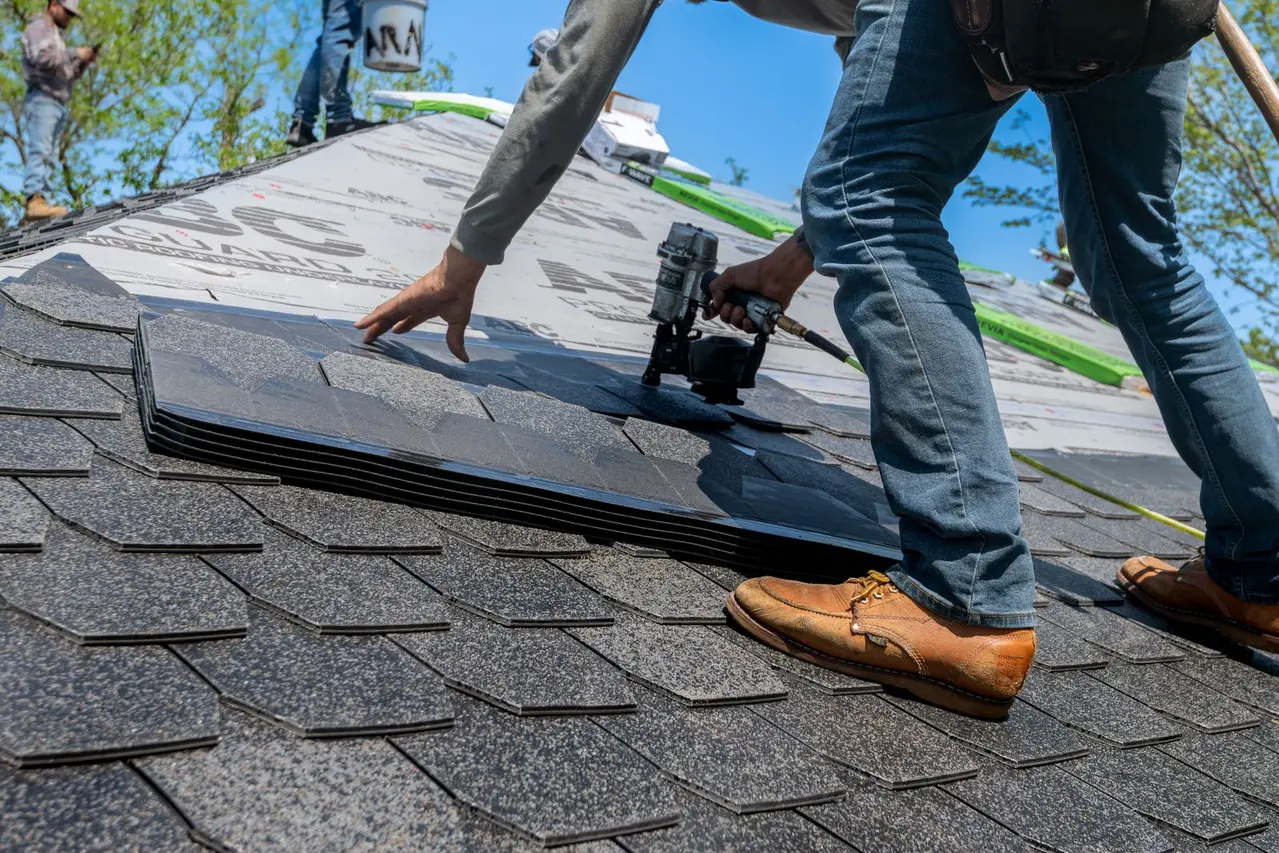
When the cause is not clear, start at the roof if the drip follows the weather. A roofer can rule the roof in or out and tell you if the duct needs attention next.
What to Do Today
- If water is near the fan's motor or light, switch the fan off at the breaker until it is dry.
- Catch the drip and protect the floor and vanity below it.
- Take a photo of the grille and the ceiling, and start your notes on time and weather.
- Dry wet drywall, insulation and towels fast. The EPA says to dry water-damaged areas within 24 to 48 hours to prevent mold.
- If the drip came with rain, call a roofer before the next storm.
Source, read November 16, 2026: U.S. EPA, A Brief Guide to Mold, Moisture and Your Home.
Questions Homeowners Ask About a Dripping Bathroom Fan
Is water dripping from a bathroom exhaust fan normal?
Some condensation inside the duct is normal in a New Jersey winter, because Newark's January nights average 25.5 degrees F (NOAA 1991-2020 normals). Water dripping out of the grille is not normal. It means the duct is too cold, the fan runs too briefly, or rain is getting in at the roof.
How do I stop condensation in my bathroom fan vent?
Run the fan longer: the Home Ventilating Institute recommends 20 minutes after the bathroom is used. Then check that the damper closes, insulate the duct where it crosses the attic, and remove sags. Fine Homebuilding suggests R-3 to R-8 insulation on the whole duct, or at least the last 6 feet before the outlet.
Why does my bathroom fan leak when it rains?
Rain is getting into the vent at the roof or wall. The Home Ventilating Institute names wind-driven rain through a faulty roof or wall jack as the second cause of fan drips. Check the cap, its damper, the flashing at its base and the shingles around it.
Do I need a permit or an electrician to replace a bathroom fan in New Jersey?
New Jersey treats replacing a bathroom exhaust fan in a home as ordinary maintenance, with no permit, provided the fan vents independently to the outdoors (N.J.A.C. 5:23-2.7(c)5.ix). A fan that vents into the attic does not meet that condition, so ask your town's construction office first. The wiring is electrical work, so hire an electrician for it.
What is the average lifespan of a bathroom exhaust fan?
InterNACHI's life expectancy chart puts a ceiling vent fan at 5 to 10 years. Use, moisture and cleaning change that. An older, weaker fan moves less air, which leaves more moisture in the duct.
How do I install a condensation trap?
A condensation trap or drip loop is a low point built into the duct that catches water before it runs back to the fan, as Family Handyman describes. It treats the drip, not the cause. Insulating the duct and running the fan longer stop the water forming in the first place.
What should I do if water is leaking around a plumbing vent pipe?
A plumbing vent pipe passes through the roof inside a rubber or metal boot. When the boot cracks, rain runs down the pipe into the ceiling, often near a bathroom. That is a roof repair; our roof vent boot repair page explains it.
Does R&E Roofing fix bathroom fan leaks?
We fix the roof side: the vent cap, the boot or collar, the flashing and the shingles around the opening. Call (667) 204-1609 or use our quote form, with your town and when the water shows up. If the cause is condensation in the duct, an HVAC contractor or an electrician is the usual call for the duct and fan.
FAQ sources, read November 16, 2026: NOAA NCEI; Home Ventilating Institute; Fine Homebuilding; N.J.A.C. 5:23-2.7; InterNACHI; Family Handyman.