Chimney Inspection Cost in New Jersey (2026): Level 1, 2 and 3 Prices, and Which One You Need
The Short Answer
- Level 1 (the yearly check): $100 to $250 according to HomeGuide (February 2026), usually with a basic cleaning. Angi's range is $100 to $950 (October 2026).
- Level 2 (with a camera in the flue): $250 to $600 (HomeGuide) or $200 to $1,000 (Angi). This is the level for a home sale, a new appliance, or after a storm or chimney fire.
- Level 3 (opening up hidden parts): $900 to $5,000 (HomeGuide) or $500 to $5,000 (Angi). It is rare.
- Nearest regional figures: Philadelphia and its suburbs, Level 1 $69 to $150 and Level 2 $129 to $350 (Franklin Chimney, March 2026). No source we found publishes a New Jersey figure.
- Selling in New Jersey: the state's resale certificate covers smoke and carbon monoxide alarms, not the chimney. The national standard NFPA 211 calls for a Level 2 at a sale.
Every price on this page is a published figure quoted from the named source with its date. None of them is R&E Roofing's price.
A chimney inspection checks that the chimney is sound, clear of soot and creosote, and safe to use. The national standard, NFPA 211, sorts inspections into three levels, and the level is the main thing that sets the price. HomeGuide calls the Level 1 an annual requirement before using the fireplace in the winter.
This guide puts the published 2026 prices in one place, shows which level fits your situation, and explains what New Jersey does and does not require when a house changes hands. If an inspection has already turned up a cracked crown, loose flashing or a missing cap, see our chimney repair page and our chimney repair cost guide for New Jersey.
Chimney Inspection Cost by Level
We found no government source for chimney inspection prices, and none of the national guides we used gives a New Jersey figure. The closest regional numbers we found come from Franklin Chimney, a Philadelphia company, for Philadelphia and the Montgomery, Delaware, Bucks and Chester County suburbs. The table sets them beside three national sources.
Chimney inspection cost by NFPA 211 level, as published by each source. None is an R&E Roofing price.Swipe the table sideways to see every column.
| Level | What it covers | HomeGuide (Feb 2026) | Angi (Oct 2026) | Brown Chimney industry range (2026) | Philadelphia area (Franklin Chimney, Mar 2026) |
|---|---|---|---|---|---|
| Level 1 | Readily accessible parts of the chimney and appliance; a light up the flue | $100 to $250 | $100 to $950 | $100 to $550 | $69 to $150 |
| Level 2 | Level 1 plus the roof, accessible attic, basement and crawl spaces, and a video scan of the flue | $250 to $600 (up to 2 flues) | $200 to $1,000 | $200 to $1,000 | $129 to $350 |
| Level 3 | Concealed parts, opening or removing parts of the chimney or wall where needed | $900 to $5,000 (up to 3 flues) | $500 to $5,000 | $500 to $5,000 | $300 to $600+ |
Brown Chimney's 2026 pricing page puts the national average for a standard inspection at around $450, and Angi says most chimneys only need a Level 1. HomeGuide says the Level 1 price usually includes a basic sweep and cleaning.
What pushes the price up
- More flues. Angi and HomeGuide both price higher for more than one flue. HomeGuide's Level 2 range covers up to 2 flues or fireplaces and its Level 3 range up to 3 flues. A chimney that serves a fireplace and a furnace has two flues to check.
- Height and the roof. Angi lists taller chimneys, steep or shaky roofs and tight access as cost factors; HomeGuide adds extra charges for larger ladders on multi-story homes.
- The camera. Angi says a remote video camera adds to the price. CSIA says a video scan of the flue is required at Level 2.
- Condition. HomeGuide says chimneys with heavy creosote take more time and tools to inspect.
- Urgency. HomeGuide says urgent or after-hours inspections cost extra.
Sources, read October 25, 2026: HomeGuide, chimney inspection cost (February 9, 2026); Angi, chimney inspection cost (updated October 19, 2026); Brown Chimney, chimney inspection cost (2026 pricing); Franklin Chimney, chimney inspection cost in Philadelphia (March 17, 2026); CSIA, Level 2 inspection of a masonry fireplace.
Which Level Do You Need?
The National Fire Protection Association added the three levels to NFPA 211 on January 13, 2000, and the Chimney Safety Institute of America (CSIA) explains when each applies. Most homes need a Level 1 in most years. The level goes up when something changes.
Which inspection level fits which situation, from CSIA's explanation of NFPA 211Swipe the table sideways to see every column.
| Level | Your situation | Why |
|---|---|---|
| Level 1 | Yearly check, chimney used the same way as last year | CSIA: the routine annual level when nothing is changing |
| Level 1 | Replacing an appliance with a similar one (gas furnace for gas furnace) | CSIA: appropriate for a like-for-like replacement |
| Level 2 | A new appliance or a different one: a gas insert in a wood fireplace, a wood stove, a new furnace of another type, fuel or efficiency | CSIA: conditions of use are changing |
| Level 2 | Buying or selling the house | CSIA: NFPA 211 calls for it upon the sale or transfer of a property |
| Level 2 | After a chimney fire, a building fire, a storm or an earthquake, or a malfunction likely to have damaged the chimney | CSIA |
| Level 2 | Before lining or relining the chimney | CSIA |
| Level 3 | A Level 1 or 2 found a likely hidden hazard that cannot be checked without opening the chimney or wall | CSIA |
Not every source agrees on the home sale. CSIA says NFPA 211 calls for a Level 2 upon the sale or transfer of a property, and HomeGuide says to use a Level 2 when buying a home with a chimney. Angi, on the other hand, calls a Level 1 the standard choice for a home sale. If the house is old, the chimney has not been checked in years, or the buyer's home inspector flagged it, the camera in a Level 2 is what shows the inside of the flue.
Sources, read October 25, 2026: CSIA, the three levels of NFPA 211 (March 15, 2000); CSIA, Level 1 inspection of a masonry chimney; CSIA, Level 2 inspection of a masonry fireplace; HomeGuide; Angi.
Buying or Selling a House in New Jersey
Before a one- or two-family home in New Jersey is sold, leased or otherwise changes occupants, the owner must get a certificate from the local enforcing agency showing the house meets the state smoke alarm and carbon monoxide alarm rules (N.J.A.C. 5:70-2.3). Since P.L. 2025, chapter 19, the certificate no longer covers a portable fire extinguisher, and a house with a secondary power source needs a warning label within 18 inches of the main electrical panel and the electrical meter.
- Smoke alarms: on each level of the house and outside each separate sleeping area (N.J.A.C. 5:70-4.19).
- Carbon monoxide alarms: near the sleeping areas in every home with a fuel-burning appliance or an attached garage (N.J.A.C. 5:70-4.19), such as a gas furnace or an oil boiler.
- The chimney: not mentioned in either text. In the state rules we read, a chimney inspection is not a condition of the sale. Your town may have its own resale rules, so ask its fire official or construction office.
That leaves the chimney to the buyer's judgment. NFPA 211 calls for a Level 2 at a sale. Our guide to what a home inspection checks on the roof shows what a home inspection usually covers on the roof and chimney. If the camera finds a cracked flue, our chimney liner cost guide covers what relining costs.
Sources, read October 25, 2026: N.J.A.C. 5:70-2.3; N.J.A.C. 5:70-4.19; P.L. 2025, c.19 (New Jersey Legislature); CSIA.
What Happens During a Chimney Inspection
Level 1
CSIA's standard procedure for a Level 1 covers the readily accessible parts of the appliance and chimney, meaning parts reached without tools or ladders. The inspector disconnects the appliance and uses a light to look up the flue. Any chimney with 1/8 inch or more of buildup is swept or recommended for sweeping, and if there are signs of a chimney fire, the inspector photographs them and recommends a Level 2. HomeGuide says a Level 1 takes 45 to 60 minutes with a basic cleaning.
Level 2
A Level 2 includes everything in a Level 1 and goes further. CSIA says the inspector goes on the roof, checks the system inside accessible attics, basements and crawl spaces, and checks every flue in the chimney and the appliances connected to it. A video scan of the chimney interior is required. HomeGuide says it takes 1 to 2 hours.
Level 3
A Level 3 is for when a Level 1 or 2 points to a hidden hazard that cannot be checked without reaching concealed areas. CSIA says it confirms the construction and condition of the concealed parts of the chimney and flue. HomeGuide says it can mean removing drywall, bricks, siding or the chimney cap; Angi says it can take up to five hours, or several days when materials have to come out.
Sources, read October 25, 2026: CSIA Level 1 procedure; CSIA Level 2 procedure; CSIA, inspection levels; HomeGuide; Angi.
Found something wrong at the top of your chimney?
R&E Roofing repairs chimney crowns, flashing and caps for Essex County homes. Call to ask whether we handle your chimney inspection, or send what the inspector found.
Gas Inserts, Wood Stoves and Furnace Swaps
Changing what the chimney serves is the most common reason to move up to a Level 2. CSIA says adding a new appliance, or replacing one with a dissimilar one of a different fuel, efficiency or type, calls for a Level 2. That covers a gas insert in an old wood fireplace, a new wood stove, and a new furnace of a different type or efficiency. HomeGuide adds that contractors prefer a Level 2 before replacing a chimney liner or repairing a connected stove or furnace.
NFPA 211's yearly inspection applies to vents as well as chimneys and fireplaces, so the vent of a gas appliance is included. Separately, every New Jersey home with a fuel-burning appliance must have a carbon monoxide alarm near the sleeping areas (N.J.A.C. 5:70-4.19).
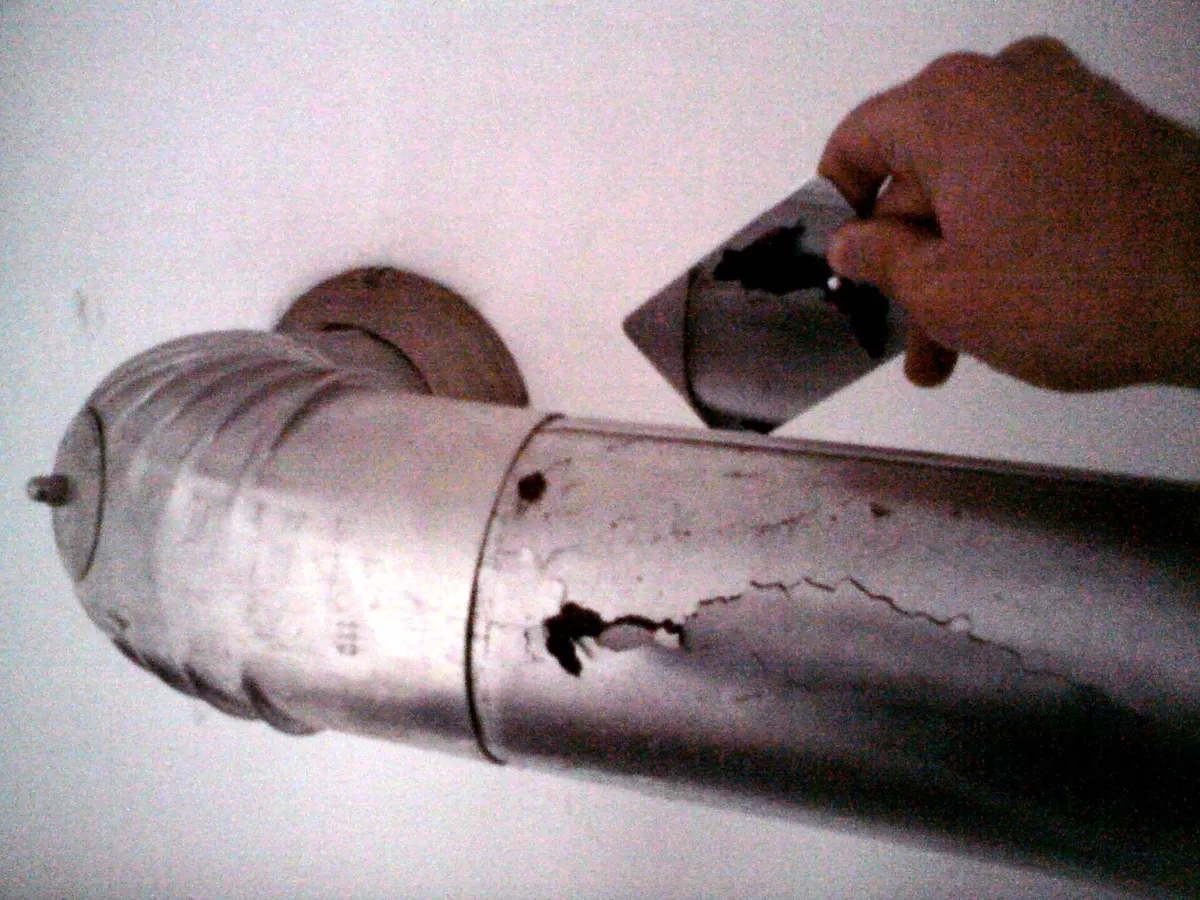
If a camera shows a cracked or missing liner after a furnace swap, our chimney liner cost guide explains the orphaned water heater problem and what each liner type costs.
Sources, read October 25, 2026: CSIA Level 2 procedure; CSIA homeowner FAQ; HomeGuide; N.J.A.C. 5:70-4.19.
Why Before the First Fire in Essex County
CSIA notes that even a chimney you rarely use may have animals nesting in the flue or other deterioration that makes it unsafe. HomeGuide calls the Level 1 an annual requirement before using the fireplace in the winter.
The weather here also works on the outside of the chimney. Newark averages 79.9 nights a year at or below 32°F but only 14.5 days that stay below freezing all day, and 31.5 inches of snow (NOAA 1991-2020 normals). So on roughly 65 days a year the air drops below freezing at night and climbs above it by day, which is when water in brick, mortar and the crown can freeze and thaw. A crack in the crown that an inspection finds in the fall has a whole winter of that ahead of it. CSIA also lists a weather event likely to have damaged the chimney as a reason for a Level 2.
Sources, read October 25, 2026: NOAA NCEI, 1991-2020 annual normals, Newark Liberty International Airport (USW00014734); CSIA; HomeGuide; CSIA Level 2 procedure.
The Parts You See From the Roof
Several things an inspection looks at are outside, at the top of the chimney and where it meets the roof: Brown Chimney lists the exterior masonry, crown, flashing and cap. These are the parts R&E Roofing repairs. Two of the rules come straight from New Jersey's one- and two-family dwelling subcode, which is the 2024 International Residential Code as adopted at N.J.A.C. 5:23-3.21. New Jersey's changes to its chimney chapter only alter clearances to combustible material, not these two rules.
- The crown or cap on top. Section R1003.9.1 says a masonry chimney shall have a concrete, metal or stone cap with a drip edge, sloped to shed water. See our chimney repair page.
- The height (the 3-2-10 rule). Section R1003.9 says a chimney shall extend at least 2 feet higher than any part of the building within 10 feet, and at least 3 feet above the highest point where it passes through the roof.
- The flashing. The metal that seals the joint between the chimney and the roof. See our chimney flashing repair page.
- The rain cap and screen over the flue. See our chimney cap installation page and the chimney cap cost guide.
- The brick and mortar joints. Worn joints are repointed; the chimney repair page explains why old brick needs the right mortar.
If you are having the chimney checked, it is a sensible time to have the roof around it looked at too. Our roof inspection page explains what that covers.
Sources, read October 25, 2026: New Jersey One- and Two-Family Dwelling Subcode 2024, chapter 10, sections R1003.9 and R1003.9.1 (UpCodes); N.J.A.C. 5:23-3.21 (NJ Department of Community Affairs, current through the New Jersey Register of August 17, 2026); Brown Chimney.
What the Repairs an Inspection Finds Cost
Angi notes that repairs are billed separately from the inspection. These are HomeGuide's national averages for the usual findings, with Angi's range for repairs found at an inspection. None is an R&E Roofing price; our chimney repair cost guide goes into each repair in more detail.
National average repair costs, HomeGuide (February 2026) and Angi (October 2026)Swipe the table sideways to see every column.
| Repair | Average cost | Source |
|---|---|---|
| Chimney repair (general) | $200 to $850 | HomeGuide |
| Chimney crown repair | $150 to $1,500 | HomeGuide |
| Chimney cap replacement | $200 to $850 | HomeGuide |
| Sealing a chimney | $150 to $400 | HomeGuide |
| Repointing a chimney | $500 to $2,500 | HomeGuide |
| Chimney liner installation | $1,500 to $4,000 | HomeGuide |
| Chimney rebuild | $1,000 to $3,500 | HomeGuide |
| Repairs found at an inspection, simple to complex | $160 to $750; complex up to $15,000 | Angi |
Sources, read October 25, 2026: HomeGuide, chimney inspection cost, related services; Angi.
Inspection or Sweep?
They are different jobs that often happen on the same visit. Franklin Chimney describes an inspection as assessing the chimney's condition and safety, with a written report, and a sweep as physically removing creosote and debris. Angi says most chimney inspectors are also chimney sweeps and will clean the chimney at the same time, and HomeGuide puts a standard sweep at $150 to $375.
How often to sweep depends on what the inspection finds. CSIA recommends sweeping a masonry fireplace at 1/8 inch of sooty buildup, sooner if there is any glaze (creosote), and a factory-built fireplace when any appreciable buildup occurs. Our chimney sweep cost guide covers sweeping itself.
Sources, read October 25, 2026: Franklin Chimney; Angi; HomeGuide; CSIA homeowner FAQ.
What to Ask Before You Book
- Which level do I need, and why?
- Is a sweep included, and is it priced separately?
- How many flues does the price cover?
- Will you check the top of the chimney from the roof?
- For a Level 2, will I get the camera footage?
- Will I get a written report, with photos of anything wrong?
- Are repairs quoted separately, in writing, before any work?
- Do you charge more for a two- or three-story house?
HomeGuide's own list of questions includes asking to see video footage of any damage found and asking for a full report with repair recommendations. Before you hire anyone for the repairs, check the contractor's state registration; our guide to the New Jersey contractor lookup shows how. If the fireplace is used often, your homeowners insurer may have its own rule: Angi notes that some insurers require a yearly inspection by a certified pro when the fireplace is used regularly.
Questions Homeowners Ask About Chimney Inspection Cost
What is the average cost of a chimney inspection?
HomeGuide puts a Level 1 chimney inspection at $100 to $250 and a Level 2 at $250 to $600 (February 2026). Angi's wider range is $100 to $5,000 across all three levels (updated October 2026), and Brown Chimney's 2026 pricing page puts the national average for a standard inspection at around $450. These are national figures, not R&E Roofing's price.
How much does a Level 2 chimney inspection cost?
HomeGuide puts a Level 2 at $250 to $600 for up to 2 flues or fireplaces, and Angi at $200 to $1,000. The nearest published regional figures are from Franklin Chimney, which puts a Level 2 in Philadelphia and its suburbs at $129 to $350 (March 2026). None of these is R&E Roofing's price.
How often should your chimney be inspected?
Once a year. The Chimney Safety Institute of America follows NFPA 211, which says chimneys, fireplaces and vents shall be inspected at least once a year for soundness, freedom from deposits and correct clearances, with cleaning, maintenance and repairs done if necessary. CSIA says this applies even if you rarely use the chimney, because animals may nest in the flue or the chimney may deteriorate.
Are chimney inspections worth it?
For a chimney you use, yes: NFPA 211 calls for one every year, and an inspection is how small problems are found before a fire or a big repair. Angi puts simple chimney repairs found during an inspection at $160 to $750 and complex ones at up to $15,000. HomeGuide puts a Level 1 at $100 to $250, usually with a basic cleaning included.
What is the 3-2-10 rule for chimneys?
A chimney must stand at least 3 feet above the highest point where it passes through the roof, and at least 2 feet higher than any part of the building within 10 feet. In New Jersey this is section R1003.9 of the one- and two-family dwelling subcode, which is the 2024 International Residential Code as adopted at N.J.A.C. 5:23-3.21.
What happens during a chimney inspection?
In a Level 1, CSIA's procedure has the inspector check the readily accessible parts of the chimney and the appliance, disconnect the appliance and look up the flue with a light, and sweep it if there is 1/8 inch or more of buildup. A Level 2 adds the roof, the accessible attic, basement and crawl spaces, and a video scan of the flue interior, which CSIA says is required at Level 2. HomeGuide says a Level 1 takes 45 to 60 minutes and a Level 2 takes 1 to 2 hours.
What is the difference between chimney sweeping and chimney cleaning?
None: they are two names for the same job, removing soot, creosote and debris from the flue. The real difference is between a sweep and an inspection. Franklin Chimney puts it this way: an inspection assesses the chimney's condition and safety and produces a written report, while a sweep physically removes creosote and debris. Angi notes that most inspectors are also chimney sweeps and will clean the chimney at the same visit.
How often does a fireplace chimney need to be cleaned?
When the buildup calls for it, which the yearly inspection tells you. CSIA recommends sweeping a masonry fireplace at 1/8 inch of sooty buildup, and sooner if there is any glaze (creosote). It says factory-built fireplaces should be swept when any appreciable buildup occurs. HomeGuide puts a standard chimney sweep at $150 to $375.
Does New Jersey require a chimney inspection when you sell a house?
Not in the state rules we read. Before a one- or two-family home is sold, New Jersey requires a certificate showing the smoke alarms and carbon monoxide alarms comply (N.J.A.C. 5:70-2.3), plus a secondary power source label where the house has one (P.L. 2025, c.19); neither text mentions the chimney. The national standard NFPA 211 calls for a Level 2 inspection upon the sale or transfer of a property (CSIA), but that is a standard, not a state sale requirement in those texts. Your town may have its own resale rules, so ask its fire official.
How long does a chimney inspection take?
HomeGuide says 45 to 60 minutes for a Level 1 with a basic cleaning and 1 to 2 hours for a Level 2. Angi says a Level 1 takes 45 minutes to two hours and a Level 3 can take up to five hours, or several days if materials have to be removed.
FAQ sources, read October 25, 2026: HomeGuide; Angi; Brown Chimney; Franklin Chimney; CSIA homeowner FAQ; CSIA, inspection levels; CSIA Level 1 procedure; CSIA Level 2 procedure; N.J.A.C. 5:70-2.3; P.L. 2025, c.19; NJ subcode R1003.9; N.J.A.C. 5:23-3.21.