
Roof Repair in Winter in Essex County, NJ: What Can Be Fixed in the Cold, and What Waits for Spring
The Short Answer
- Yes, a roof can be repaired in winter. GAF says there is no practical lower temperature limit for applying asphalt shingles, as long as appropriate precautions are taken.
- Workable days come every month. At Newark Liberty International Airport the high reaches 40°F on 21.9 days in December, 15.9 in January and 17.2 in February (NOAA 1991-2020 normals).
- Repaired shingles are hand-sealed in the cold. GAF lists both repairs and cold weather as times to hand-seal. Owens Corning calls for four 1-inch dabs of roof cement per perimeter shingle at or below 40°F.
- The cement has a limit too. GAF's MATRIX 203 plastic roof cement goes on at 45°F and rising, and must not freeze.
- Ice and frost stop the work. The Asphalt Roofing Manufacturers Association advises waiting until the roof surface is free of ice and frost.
- No permit is needed to repair the roof covering on a detached one- or two-family house in New Jersey.
- Many Essex County roofs were never required to have an ice barrier. New Jersey requires one only in Sussex County, so an older roof here may have nothing at the eaves to stop melt water backed up behind ice.
Every figure here is quoted from a source listed at the foot of the page, read on November 19, 2026. R&E Roofing's prices are in a written estimate for your roof, not on this page.
The three pages Google showed first in New Jersey for "roof repair in winter" on November 19, 2026 came from roofers in Florida, Maryland and South Dakota. None gave winter day counts for New Jersey, New Jersey's code rules, or the temperature limits in the shingle makers' own technical bulletins. This guide gives all three for Essex County, where R&E Roofing works from its office at 573 Valley St in Orange.
For what a roof repair covers, see our roof repair service. If water is coming in right now, skip to what to do tonight. The estimate form is at the bottom of this page.
How Many Winter Days Are Warm Enough for a Roof Repair?
Shingle makers draw their cold-weather line at 40°F. GAF says handling is easiest above 40°F. Owens Corning's cold-weather procedures start when the air and the roof surface are at or below 40°F. So the useful question is how often an Essex County afternoon gets past that line.
NOAA's 1991-2020 normals for Newark Liberty International Airport answer it. They are 30-year averages, not a forecast for any one week.
Newark Liberty International Airport, NOAA 1991-2020 monthly normals. Swipe the table sideways to see every column.
| Month | Average high | Average low | Days the high reaches 40°F | Days the high reaches 50°F | Nights at or below 32°F | Snowfall |
|---|---|---|---|---|---|---|
| December | 44.8°F | 31.2°F | 21.9 | 9.6 | 17.5 | 5.4 in |
| January | 40.0°F | 25.5°F | 15.9 | 5.7 | 22.6 | 9.1 in |
| February | 43.0°F | 27.2°F | 17.2 | 7.1 | 20.0 | 10.1 in |
| March | 50.9°F | 34.2°F | 27.5 | 15.8 | 12.4 | 5.6 in |
What the table means for a repair:
- Even January averages 15.9 days with a high of 40°F or more, so there are workable afternoons in every winter month.
- Days at 50°F are scarcer: 5.7 in January against 15.8 in March. Work that needs real warmth is easier to book from March.
- The averages put the highs above freezing and the lows below it in every winter month. Snow on a roof melts by day and can refreeze at the cold eaves by night.
- Newark averages 79.9 nights a year at or below 32°F, and 60.1 of them fall in December, January and February.
- Average snowfall is 31.5 inches a year, most of it in January and February.
Sources, read November 19, 2026: NOAA NCEI monthly normals, Newark, NOAA NCEI annual and seasonal normals, Newark, GAF TAB-R-133, Owens Corning cold weather bulletin.
What a Roofer Can Repair in Cold Weather
Many leak repairs are local: a few shingles, a run of flashing, a seam. They can be done on a dry winter day when the roofer follows the cold-weather rules the makers publish.
Missing, torn or lifted shingles
Cold shingles are stiff. GAF says that in very cold weather they may become brittle and crack, break or delaminate when bent. It suggests storing shingles in a heated area above 70°F for at least 24 hours before use, if possible.
A new shingle also will not bond on its own in the cold. Its sealant strip is activated by the sun's heat, and Owens Corning says shingles put on in cold weather may not seal until warmer temperatures arrive. So the makers call for hand-sealing:
- GAF's hand-sealing bulletin lists "while performing repairs" and "in cold weather, fall or winter" among the times to hand-seal.
- Owens Corning calls for four 1-inch dabs of ASTM D4586 asphalt roof cement on each perimeter shingle at or below 40°F.
- Owens Corning also warns that too much roof cement can make shingles blister.
Flashing at chimneys, walls, vents and skylights
Flashing repairs are finished with roof cement or sealant, so the cement's own limit applies. GAF's MATRIX 203 plastic roof cement data sheet says to apply it only when temperatures are 45°F and rising, to store it for 24 hours at room temperature first, not to use it on wet or damp surfaces, and not to let it freeze. Ask which product your roofer will use and what its data sheet allows.
For how a leak is traced to the flashing or the shingles, see our Essex County roof leak repair guide.
Storm damage and temporary covers
After wind or a fallen limb, the first job is keeping water out. A tarp or temporary cover does not rely on a shingle's sealant strip, so it can hold until a day warm enough for the finished repair.
Flat roofs on two- to four-family buildings
Newark, Irvington, East Orange and Orange have large shares of homes in two- to four-family buildings (see the town table below). Where such a building has a flat or low-slope roof, a membrane patch uses adhesives and primers, and each product's data sheet sets its own minimum application temperature. Ask for the product name and that limit before a winter patch is booked.
Sources, read November 19, 2026: GAF TAB-R-133, GAF TAB-R-114, GAF MATRIX 203 data sheet, Owens Corning cold weather bulletin.
What Usually Waits for Spring
- Any work on an icy or frosted roof. The Asphalt Roofing Manufacturers Association warns that nearly invisible ice or frost can make roof work extremely hazardous, and advises waiting until the surface is free of ice and frost.
- Walking a brittle roof for a long job. The same association says shingles that are curved or buckled are very susceptible to breakage underfoot in frigid weather.
- A full replacement you can schedule. A roof can be replaced in winter with the makers' precautions, but a planned re-roof has more warm days to choose from in March than in January. Our guide to the best time to replace a roof in New Jersey covers the timing.
- A new eave membrane. Adding one means lifting the lower courses of shingles, which GAF's cold-weather bulletin warns can crack when bent in very cold weather. It is easier to plan for a warmer stretch.
The repair that stops the water should not wait. The planned work around it can.
Sources, read November 19, 2026: Asphalt Roofing Manufacturers Association, cold-weather recommendations, GAF TAB-R-133.
Why Essex County Roofs Leak in Winter
New Jersey's building code requires an ice barrier, a sealed membrane at the eaves, only where the average daily temperature in January is 25°F or less. The Department of Community Affairs says that in New Jersey this area is Sussex County. Newark's January average is 32.8°F.
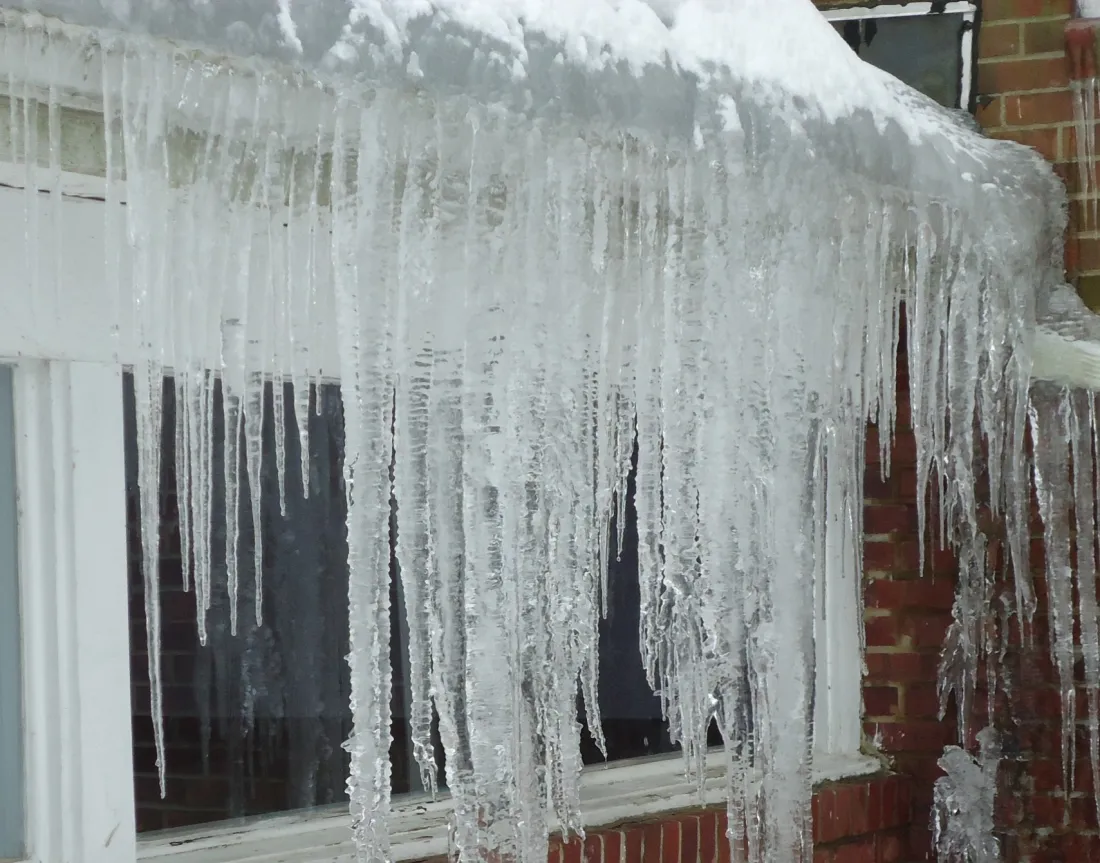
So the code has not required an eave membrane on Essex County houses. Owens Corning's instructions still recommend an ice and water barrier at the eaves wherever roofs have had a history of ice damming. On a roof without one, melt water that backs up behind ice at the gutter line can work its way under the shingles.
Common sources of a winter roof leak:
- Ice dams at the eaves. See how to prevent ice dams in New Jersey and ice dam damage repair costs.
- Chimney and wall flashing that has cracked or pulled away.
- Shingles lifted or torn off by winter wind.
- Valleys, where melt water from two roof planes meets.
- Frost in the attic that melts and drips, which is not a roof leak at all. See attic condensation and roof moisture.
Before the coldest weeks, the New Jersey winter roof checklist lists what to look at from the ground.
Sources, read November 19, 2026: NJ DCA Bulletin 07-3, Ice Dam Membrane/Ice Barrier (PDF), NOAA NCEI monthly normals, Newark, Owens Corning Supreme installation instructions.
Your Town's Housing and What It Means for a Winter Repair
The age and type of a town's houses shape which winter repairs come up. The table covers the Essex County towns around our Orange office. Each town name links to our roof repair page for that town.
Share of all homes, American Community Survey 2020-2024 5-year estimates. Swipe the table sideways to see every column.
| Town (roof repair page) | Median year built | Built 1939 or earlier | In 2-unit buildings | In 3- or 4-unit buildings |
|---|---|---|---|---|
| Belleville | 1951 | 32% | 20% | 8% |
| Bloomfield | 1950 | 38% | 13% | 15% |
| East Orange | 1956 | 32% | 14% | 13% |
| Essex Fells | 1954 | 36% | 1% | 2% |
| Glen Ridge | 1939 or earlier | 81% | 2% | 1% |
| Irvington | 1960 | 24% | 20% | 19% |
| Livingston | 1962 | 9% | 0% | 1% |
| Maplewood | 1939 or earlier | 55% | 15% | 3% |
| Millburn (incl. Short Hills) | 1954 | 33% | 6% | 3% |
| Montclair | 1939 or earlier | 59% | 10% | 9% |
| Newark | 1966 | 24% | 18% | 22% |
| Nutley | 1953 | 31% | 12% | 8% |
| Orange | 1958 | 28% | 13% | 13% |
| Roseland | 1975 | 15% | 2% | 3% |
| South Orange | 1946 | 44% | 5% | 1% |
| Verona | 1954 | 33% | 6% | 4% |
| West Orange | 1956 | 25% | 11% | 6% |
Older housing: Glen Ridge, Montclair and Maplewood
In Glen Ridge 81% of homes were built in 1939 or earlier, in Montclair 59% and in Maplewood 55%. On houses that old, the age of the roof covering and the chimney flashing are the first things to check in a freeze-thaw winter, and the code has not required an eave membrane here. Montclair says maintenance and repair of existing roofing materials with no change in the design, scale or appearance of the structure does not need a Certificate of Appropriateness in its historic districts. Our Essex County roof cost guide covers when a change of roofing material needs review.
Two- to four-family buildings: Newark, Irvington, East Orange and Orange
In Newark 18% of homes are in two-unit buildings and 22% in three- or four-unit buildings. In Irvington the figures are 20% and 19%, in East Orange 14% and 13%, and in Orange 13% and 13%. Where one of these buildings has a flat or low-slope roof, the membrane product's temperature limit decides whether a winter patch can be finished.
Newer single-family streets: Livingston and Roseland
In Livingston the median home was built in 1962 and in Roseland in 1975. With newer houses, a winter leak is worth tracing before anyone assumes the roof is worn out: wind-lifted shingles, vent and skylight flashing, and attic condensation all show up as winter leaks.
We also have roof repair pages for the Union County towns at the edge of the same area: Union, Springfield, Summit, Hillside.
Sources: Census Reporter, American Community Survey 2020-2024 5-year estimates (read November 18, 2026), Township of Montclair, Certificate of Appropriateness (read November 18, 2026).
If the Roof Leaks Tonight
- Catch the water. Put a bucket under the drip and move furniture and electronics out of the way.
- If a ceiling bulges with water, keep people out from under it.
- Take dated photos of the stain, the drip and anything damaged. Your insurer will ask for them.
- Stay off the roof. Ice and frost can be nearly invisible.
- Call us at (667) 204-1609. Office hours are Monday to Friday, 9 to 5, and we take emergency calls on nights and weekends.
Our emergency roof repair page covers what happens after the call.
Permits and Sales Tax on a Winter Roof Repair
- Permit: New Jersey treats "the repair or replacement of existing roof covering on detached one- and two-family dwellings" as ordinary maintenance. No permit, inspection or notice is required for it.
- Not covered by that rule: any work affecting structural or fire safety. Attached homes, such as townhouses and row houses, are not named in the roof line, so ask your town's construction office first.
- Emergency work: work that does need a permit may start in an emergency, with notice given as soon as practicable and the permit applied for within 72 hours.
- Sales tax: the Division of Taxation says installing replacement shingles is repairing real property, so the charges are subject to tax. A new roof is an exempt capital improvement when the owner gives the contractor a completed Form ST-8.
Sources, read November 19, 2026: N.J.A.C. 5:23-2.7, N.J.A.C. 5:23-2.14, NJ Division of Taxation, Sales and Use Tax FAQ.
Questions Homeowners Ask About Winter Roof Repair
Can roof repairs be done in the winter?
Yes. GAF says there is no practical lower temperature limit for applying asphalt shingles as long as appropriate precautions are taken, and it lists performing repairs and working in cold weather among the times to hand-seal shingles. At Newark Liberty International Airport, NOAA's 1991-2020 normals show the afternoon high reaching 40 degrees F on 21.9 days in December, 15.9 in January and 17.2 in February. Roofs covered in ice or frost are the exception: the Asphalt Roofing Manufacturers Association advises waiting until the surface is free of ice and frost.
What temperature is too cold to repair a shingle roof?
There is no single cut-off. GAF puts the easiest handling above 40 degrees F. Owens Corning's cold-weather procedures apply when the air and surface temperatures are at or below 40 degrees F, and call for hand-sealing perimeter shingles with four 1-inch dabs of asphalt roof cement. The cement has its own limit: GAF's MATRIX 203 plastic roof cement data sheet says to apply it only when temperatures are 45 degrees F and rising, and not to let it freeze.
Will new shingles seal if they are put on in winter?
Not right away. Owens Corning says shingles installed in cold weather may not immediately seal until warmer temperatures activate the sealant, and GAF says hand sealing may be required when it is too cold to activate the adhesive promptly. That is why both makers call for hand-sealing in cold weather.
Does my Essex County roof have ice and water shield at the eaves?
Not necessarily. New Jersey requires an ice barrier only where the average daily temperature in January is 25 degrees F or less, and the state's Bulletin 07-3 says that area is Sussex County. Newark's January average is 32.8 degrees F (NOAA 1991-2020 normals). Owens Corning's instructions still recommend an ice and water barrier at the eaves wherever roofs have had a history of ice damming.
Do I need a permit for a winter roof repair in Essex County?
Not for the roof covering on a detached one- or two-family house. New Jersey's code lists the repair or replacement of existing roof covering on detached one- and two-family dwellings as ordinary maintenance, with no permit, inspection or notice. Work affecting structural or fire safety is not ordinary maintenance, and attached homes are not named in that line, so ask your town's construction office. Emergency work that does need a permit can start first, with the permit applied for within 72 hours.
Is a roof repair taxed in New Jersey?
Yes. The New Jersey Division of Taxation says installing replacement shingles is repairing real property and the charges are subject to tax. A new roof is different: it is an exempt capital improvement when the owner gives the contractor a completed Form ST-8.
Should I wait until spring to fix a roof leak?
Not the leak itself. Water left running into a ceiling or wall keeps doing damage. A temporary cover or a small repair on a workable day can stop it, and work that needs warmer weather, such as a planned re-roof or a new eave membrane, can be booked for spring. At Newark, NOAA's normals show the high reaching 50 degrees F on 15.8 days in March, against 5.7 in January.
Sources
Read November 19, 2026, except the Census table and the Montclair page (November 18, 2026).
- NOAA NCEI, 1991-2020 monthly normals, Newark Liberty International Airport (station USW00014734)
- NOAA NCEI, 1991-2020 annual and seasonal normals, Newark Liberty International Airport
- GAF, TAB-R-133 Temperature Extremes and Fiberglass Asphalt Shingles (PDF)
- GAF, TAB-R-114 Hand-Sealing Shingles (PDF)
- GAF, MATRIX 203 Plastic Roof Cement data sheet (PDF)
- Owens Corning, Cold Weather Shingle Installation technical bulletin (PDF)
- Owens Corning, Supreme shingles installation instructions
- Asphalt Roofing Manufacturers Association, Recommendations for Installation of Asphalt Roofing Shingles in Cold Weather (PDF)
- N.J.A.C. 5:23-2.7, Ordinary maintenance
- N.J.A.C. 5:23-2.14, Construction permits, when required
- NJ Department of Community Affairs, Bulletin 07-3, Ice Dam Membrane/Ice Barrier (PDF)
- NJ Division of Taxation, Sales and Use Tax FAQ
- Census Reporter, American Community Survey 2020-2024 5-year estimates for Essex County municipalities
- Township of Montclair, Certificate of Appropriateness