Chimney Leaking When It Rains? Causes, Who Fixes It, and Repair Costs in Essex County, NJ
Water coming in at the chimney now? R&E Roofing takes emergency calls on nights and weekends.
The Short Answer
Most chimney leaks start in one of five places: the metal flashing where the chimney meets the roof, a missing cricket behind a wide chimney, the cap, a cracked concrete crown, or porous brick and mortar. A roofer fixes the flashing, the cricket and the cap. The brick, mortar and crown are masonry work, which a mason does and some roofers do too; R&E Roofing repairs all five. A damaged flue liner is a job for a chimney sweep.
- Most common fix: chimney flashing repair or replacement, $400 to $1,600 with a $1,000 national average (Angi, September 2026). A reseal of sound flashing starts around $200.
- Full range: $400 to $7,000 depending on the cause, from flashing work to a new flue liner (Angi, August 2026).
- Insurance in New Jersey: sudden storm damage may be covered; wear and tear and slow, repeated seepage are not (NJ Department of Banking and Insurance policy summary).
- It is not normal: New Jersey's residential code requires a sloped cap with a drip edge on masonry chimneys and a flashed cricket behind chimneys wider than 30 inches that do not meet the ridge. Water inside means something failed.
Every price on this page is a national figure quoted from the named source with its date. None of them is R&E Roofing's price.
A water stain on the ceiling next to the chimney, a wet spot on the hearth after a storm, or a drip in the attic all point to the same question: where is the water getting in, and who do you call? The answer decides whether you need a roofer, a mason or a chimney sweep, and whether the bill is a few hundred dollars or several thousand.
This guide walks through the five places rain gets into a chimney, the signs of each, and who fixes it. It quotes 2026 national price ranges with their dates, explains what a New Jersey homeowners policy covers, and covers the state code rules that decide whether a chimney is built to shed water. For a full price breakdown by repair, see our chimney repair cost guide. This is general information, not insurance or legal advice.
Where the Water Gets In: Five Causes and Their Signs
The stain inside is rarely right under the opening outside. Water runs along rafters and sheathing before it shows. So start from the signs, then match them to the part that failed. The table lists who usually fixes each one and the published national price range for that repair.
Chimney leak sources, signs, who fixes them and published national prices (not R&E prices). Swipe the table sideways to see every column.
| Where the water gets in | Signs you may see | Who fixes it | Published price (source, date) |
|---|---|---|---|
| Chimney flashing (step and counter flashing) | Stains on the ceiling or wall beside the chimney; wet rafters or sheathing along its sides in the attic; gaps between the metal and the brick; rust stains running down the chimney | Roofer | Reseal from about $200; repair or replace $400 to $1,600, average $1,000 (Angi, updated Sep 23, 2026) |
| Missing or failed cricket (saddle) on the uphill side | Leak shows up at the back of the chimney; leaves and water sit behind it after rain; chimney wider than 30 inches with no peaked saddle behind it | Roofer | Cricket repair $700 to $1,300 (Bob Vila, updated Oct 6, 2023) |
| Missing or damaged chimney cap | Water in the firebox; rusty damper; animals or debris in the flue | Roofer or chimney sweep | Cap replacement $200 to $850 (HomeGuide, Jan 22, 2026) |
| Cracked concrete crown on top of the chimney | Visible cracks on top; water running down inside the chimney; staining near the fireplace | Mason, chimney sweep, or a roofer that does chimney masonry (R&E does) | Crown repair $200 to $700+; crown replacement $1,000 to $3,000 (HomeGuide, Jan 22, 2026) |
| Porous brick or worn mortar joints | Crumbling mortar; damp patches on the chimney walls inside; white powder on the bricks | Mason, or a roofer that does chimney masonry (R&E does) | Repointing $500 to $2,500; sealing a leak $150 to $500; full waterproofing $800+ (HomeGuide, Jan 22, 2026) |
A quick way to narrow it down
- Water beside the chimney (ceiling or wall next to it, wet wood along its sides in the attic): start with the flashing and the cricket. Those sit where the chimney passes through the roof.
- Water inside the fireplace (wet firebox, rusty damper): the water is coming down the inside. Look at the cap, the crown and the flue. Angi notes a leaking flue liner is hard to spot without a professional inspection.
- Damp brick indoors or white powder on the bricks: Angi says that powdery white film is a sign of moisture passing through the masonry. That points to brick and mortar.
For other leak sources around the house, our ceiling water stain diagnosis guide covers stains that are not near a chimney.
Sources, read November 20, 2026: Angi, chimney flashing repair cost; Angi, chimney leaking inside the house; HomeGuide, chimney repair cost; Bob Vila, chimney repair cost.
Do Roofers Repair Chimneys?
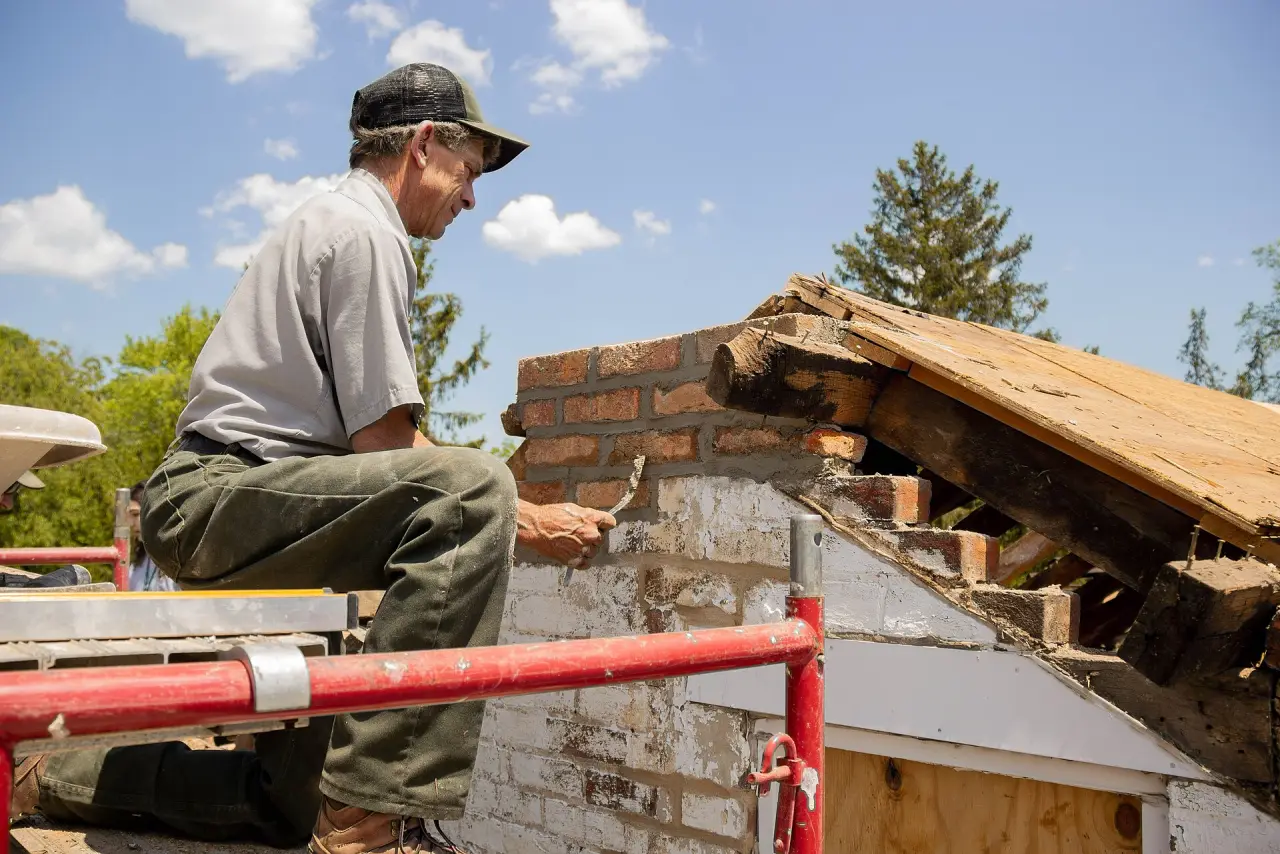
Short answer: roofers repair the parts of a chimney leak that belong to the roof: the metal flashing where the chimney meets the shingles, the cricket (saddle) on the uphill side, and the cap. The brick, mortar and concrete crown are masonry, which a mason does and some roofers, R&E Roofing among them, also repair. The flue liner is chimney-sweep work. If damaged flashing is the source, Bob Vila says a roofer is the best person to call.
That split matters because a chimney leak is often two problems at once. Bob Vila notes that homeowners are often unsure whether to call a roofer or a chimney sweep, and that a chimney sweep inspects and repairs the chimney itself. A good first visit tells you which parts are roof work and which are masonry, so each trade quotes only its own part.
What R&E Roofing fixes at the chimney
- Chimney flashing repair and replacement: step flashing woven into the shingle courses and counter flashing set into the mortar joints, in copper, lead-coated copper, aluminum or galvanized steel, and sealant replacement. See our chimney flashing repair service.
- Crickets (saddles): built on the uphill side of the chimney to send water and debris around it.
- Chimney caps: stainless steel, copper and galvanized caps sized to the flue. See our chimney cap installation service.
- Chimney masonry: repointing worn mortar joints, crown repair and replacement, replacing damaged brick, and rebuilding the top of the chimney above the roofline. See our chimney repair service.
If the water is coming down through a cracked or damaged flue liner, or the chimney needs sweeping, call a chimney sweep for that part.
Source, read November 20, 2026: Bob Vila, leaking chimney.
Chimney Flashing: The Most Common Leak
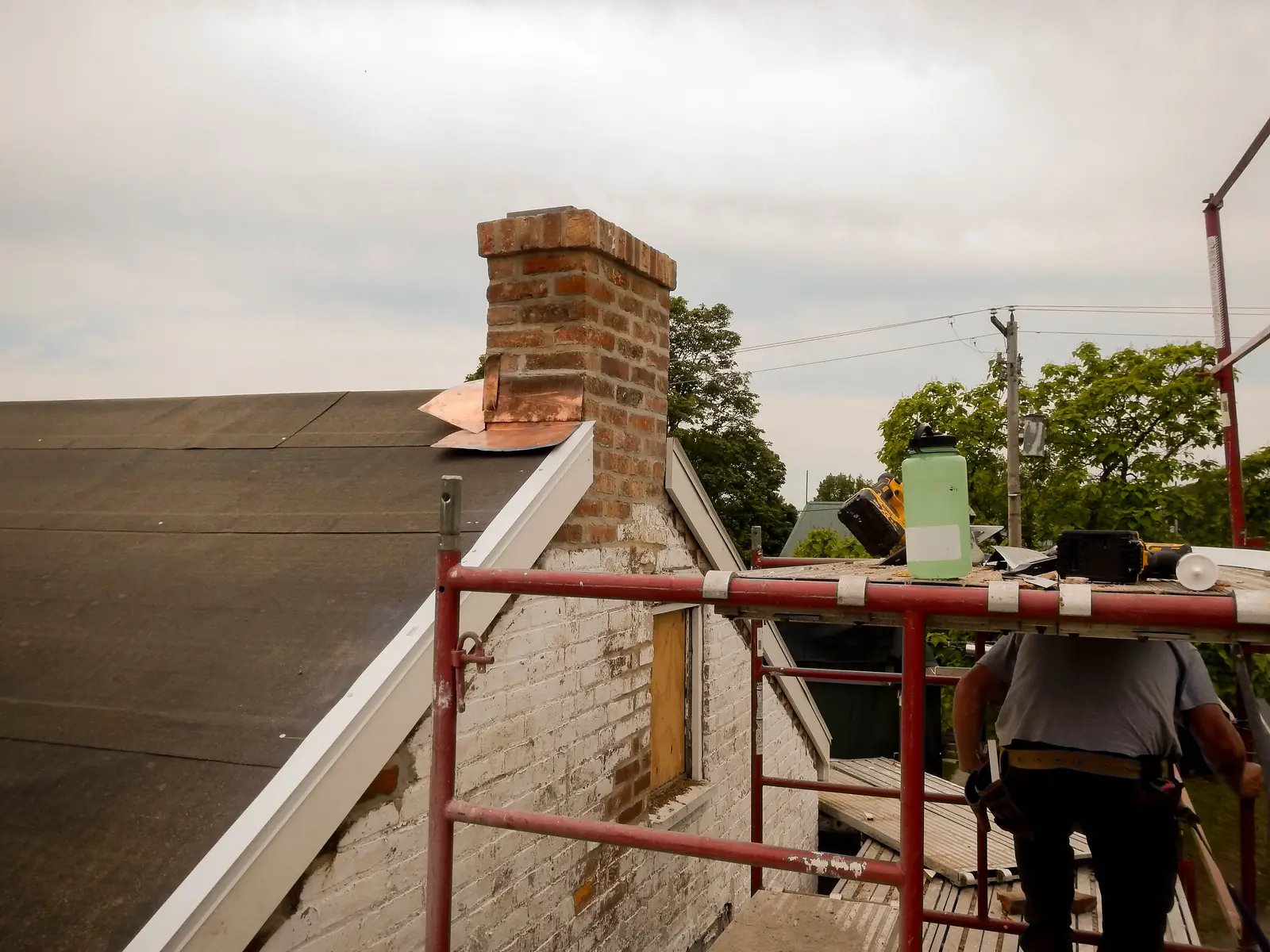
Flashing is the metal that seals the joint between the chimney and the roof. It has two layers that work together. Step flashing is a row of L-shaped pieces woven into the shingle courses along each side. Counter flashing is set into the mortar joints of the chimney and folds down over the step flashing. When either layer lifts, rusts or loses its sealant, water runs straight past the shingles.
Reseal or replace?
Angi draws the line at the metal. If the leak is failed sealant and the metal is sound, a professional strips the old sealant and applies fresh, which Angi says can cost as little as $200. If the metal is rusted, bent or corroded, it needs a full replacement, typically $400 to $1,600 or more. Angi prices step flashing at $400 to $600 and continuous flashing at $800 to $1,000, and says to budget toward the higher end of the range for an unusually large or natural stone chimney.
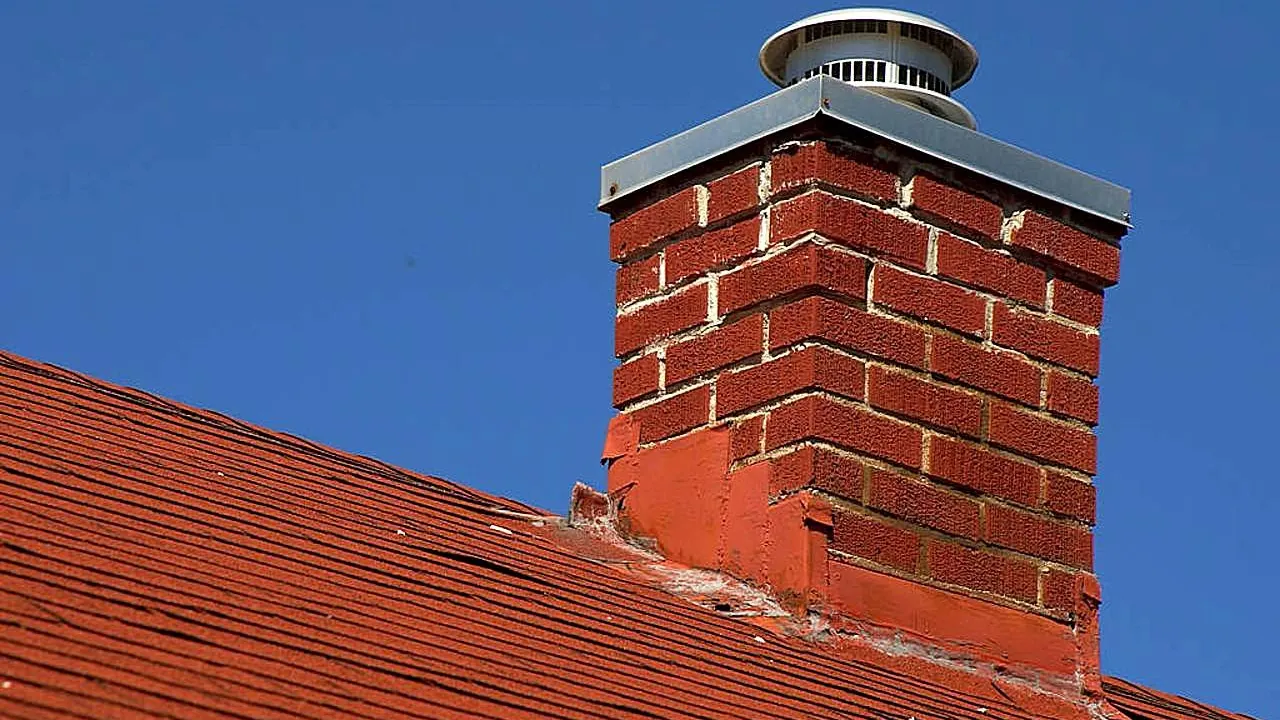
Thick layers of tar or caulk smeared over the base of a chimney, like the patches in the photo at the top of this page, usually mean it has been patched before. Ask whoever inspects it whether the metal underneath is still sound.
The cricket behind a wide chimney
A cricket, also called a saddle, is a small peaked roof built on the uphill side of a chimney so water splits around it instead of pooling against the brick. New Jersey's one- and two-family dwelling code (section R1003.20) requires one when the chimney's width parallel to the ridge is more than 30 inches and the chimney does not meet the ridgeline, and requires the cricket to be flashed and counterflashed like the rest of the chimney. Bob Vila puts cricket repair at $700 to $1,300.
For flashing at valleys, walls, vents and skylights, see our roof flashing guide.
Sources, read November 20, 2026: Angi, chimney flashing repair cost (updated Sep 23, 2026); New Jersey UCC One- and Two-Family Dwelling Subcode 2024, chapter 10, section R1003.20; Bob Vila, chimney repair cost (updated Oct 6, 2023).
How Much It Costs to Fix a Chimney Leak
Short answer: fixing a chimney leak costs $400 to $7,000 nationally, depending on the cause (Angi, updated August 4, 2026). Flashing, the most common cause, runs $400 to $1,600, with a $1,000 national average (Angi, updated September 23, 2026). Sealing a minor leak runs $150 to $500 (HomeGuide, January 22, 2026).
The cause sets the price, which is why the table above prices each source separately. Angi's leak guide gives these ranges by fix: flashing repair $400 to $1,600, crown replacement $400 to $2,200, and repointing $500 to $2,500. HomeGuide puts repointing at $500 to $2,500 in its table and gives a basic chimney inspection at $100 to $300.
Two things push any quote up. The first is access: Angi says steep roofs and tall, multi-story homes cost more to work on. The second is time: HomeGuide notes that a $200 repair today can prevent a $2,000 repair later if moisture damage spreads.
These are national figures. None of them is an R&E Roofing price. For prices by repair type, see our chimney repair cost guide; for caps, our chimney cap cost guide for New Jersey; and for mortar joints, our chimney repointing cost guide.
Want a written, itemized estimate for a chimney leak in Essex County, with photos of what we find?
Sources, read November 20, 2026: Angi, chimney leaking inside the house (updated Aug 4, 2026); Angi, chimney flashing repair cost (updated Sep 23, 2026); HomeGuide, chimney repair cost (Jan 22, 2026).
Does Insurance Cover a Leaking Chimney?
Short answer: it depends on what caused the leak. The New Jersey Department of Banking and Insurance's homeowners policy summary lists sudden and accidental water damage, windstorm or hail, and the weight of ice, snow or sleet as covered. It lists wear and tear, rotting, maintenance, and water damage from continuous and repeated seepage as not covered.
Here is how that tends to play out at a chimney:
- More likely covered: a windstorm tears the flashing loose or blows the cap off, and rain comes in that night. That is a sudden event from a listed cause.
- Less likely covered: old flashing or mortar has been letting water in a little at a time for months. The summary excludes wear and tear and continuous, repeated seepage.
- Mold: the summary excludes mold unless it results from a covered loss.
The summary itself says it does not change your coverage and that your policy is the contract. Read your declarations page and your policy, and call your agent or insurer before you assume either way. If you file, photos with dates and a written, itemized repair estimate help the adjuster see what happened.
Source, read November 20, 2026: NJ Department of Banking and Insurance, Homeowners Insurance policy summary (Exhibit A).
Is It Normal for a Chimney to Leak When It Rains?
Short answer: no. A masonry chimney is built to shed water. New Jersey's residential code requires a sloped concrete, metal or stone cap with a drip edge on top (section R1003.9.1), and a flashed cricket behind any chimney wider than 30 inches that does not meet the ridge (section R1003.20). Water inside after rain means one of those parts, the flashing or the masonry has failed.
Note the wording: the code's "cap" in section R1003.9.1 is the sloped top of the chimney, which most people call the crown. The metal hood with a screen that sits over the flue is what most people call a chimney cap. A crack in the first lets water into the masonry. A missing second lets rain fall straight down the flue.
One exception to watch for: Bob Vila notes that chimney sweeps look for condensation as well as rusted caps and damaged masonry. Moisture inside a flue is not always rain, which is one more reason to have the source confirmed before paying for a repair.
Sources, read November 20, 2026: New Jersey UCC One- and Two-Family Dwelling Subcode 2024, sections R1003.9.1 and R1003.20; Bob Vila, leaking chimney.
What to Do the Night Your Chimney Leaks
- Catch the water. Put a bucket or towels under the drip and move furniture and rugs away from the wet spot.
- Photograph it with the date. Take pictures of the stain, the drip and anything wet. If you end up filing a claim, the timing matters (see the insurance section above).
- Look from the attic, not the roof. With a flashlight, check the wood along the sides and back of the chimney. Wet wood beside it points to flashing or the cricket. Do not climb onto a wet roof.
- Hold off on fires if water reaches the fireplace. Angi warns that water getting in through a cracked crown also damages the flue liner, which raises the risk of chimney fires and carbon monoxide leaks. Have it inspected before the next fire.
- Call the right trade. Water beside the chimney usually means the flashing or the cricket. Water in the firebox can come from the cap, the crown or the flue liner: the cap and crown are repairs R&E Roofing makes, and a damaged liner is a job for a chimney sweep.
If the leak is coming through the roof around the chimney, R&E Roofing takes emergency calls on nights and weekends. See our emergency roof repair page for what happens on an urgent call, or our roof leak repair page for leaks elsewhere on the roof. If the leak started in cold weather, our guide to roof repair in winter in Essex County covers what can be fixed in the cold and what waits for spring.
Source, read November 20, 2026: Angi, chimney leaking inside the house.
Why Older Essex County Chimneys Leak
Age is the common thread. In the City of Orange, where R&E Roofing is based, 52.5% of homes were built before 1960 (U.S. Census Bureau, American Community Survey 2020-2024, table B25034). Chimneys on houses that old have been through decades of freeze and thaw. As our chimney flashing repair page notes, the original lead flashing on older Essex County homes may have reached the end of its life, and the mortar joints that hold counter flashing in place wear out too.
Older chimneys were also built before today's code. A wide chimney with no cricket behind it does not meet section R1003.20 for new work, and it is one of the first things to check when a leak shows up at the back of the chimney.
The cheapest repair is the one caught early. The Chimney Safety Institute of America follows NFPA Standard 211, which says chimneys, fireplaces and vents shall be inspected at least once a year. The U.S. Fire Administration says the same: have chimneys cleaned and inspected each year by a professional. Before the first fire of the season is a good time to have both the chimney and the flashing looked at; a stain that appears mid-winter is a reason not to wait for the yearly visit.
Sources, read November 20, 2026 (Census figures pulled November 20, 2026): U.S. Census Bureau, ACS 2020-2024 5-year, table B25034, City of Orange township (via Census Reporter); NJ One- and Two-Family Dwelling Subcode 2024, section R1003.20; Chimney Safety Institute of America, homeowner resources; U.S. Fire Administration, heating fire safety.
Questions Homeowners Ask About Chimney Leaks
Do roofers repair chimneys?
Roofers repair the parts of a chimney leak that belong to the roof: the metal flashing where the chimney meets the shingles, the cricket (saddle) that sheds water off the uphill side, and the cap on top. The brick, the mortar and the concrete crown are masonry: a mason repairs them, and some roofers do too. R&E Roofing repairs the flashing, crickets, caps, crowns, mortar joints and brick, and rebuilds the top of a chimney above the roofline. A damaged flue liner is chimney-sweep work. Bob Vila puts the first part the same way: if damaged flashing is the source, a roofer is the best person to call.
How much does it cost to fix a chimney leak?
It depends on where the water gets in. Angi (updated September 23, 2026) puts chimney flashing repair or replacement at $400 to $1,600, with a $1,000 national average, and says resealing a minor flashing leak starts around $200. Angi's chimney leak guide (updated August 4, 2026) puts the full range at $400 to $7,000. HomeGuide (January 22, 2026) lists a cap at $200 to $850, crown repair at $200 to $700 or more and sealing a chimney leak at $150 to $500. These are national figures, not R&E Roofing prices.
Does homeowners insurance cover a leaking chimney?
Sometimes. The New Jersey Department of Banking and Insurance's homeowners policy summary lists sudden and accidental water damage, windstorm or hail, and the weight of ice, snow or sleet as covered causes of loss. It lists wear and tear, rotting, maintenance, and water damage from continuous and repeated seepage as not covered. So flashing torn loose in a storm may be covered, while a slow leak from old flashing usually is not. Your own policy decides.
Is it normal for a chimney to leak when it rains?
No. A masonry chimney is built to shed water. New Jersey's residential code requires a sloped concrete, metal or stone cap with a drip edge on top of a masonry chimney, and a flashed cricket behind any chimney wider than 30 inches that does not meet the ridge. Water inside after rain means one of those parts, the flashing, or the masonry has failed. Bob Vila notes that chimney sweeps also check for condensation, which can look like a leak.
What should I do if my chimney is leaking right now?
Catch the water, move furniture and rugs away from the wet spot, and photograph the stain with the date for any insurance claim. Look in the attic along the chimney with a flashlight to see where the wood is wet. Do not climb onto the roof in rain. If water is reaching the fireplace or flue, hold off on fires until it is inspected, because water can damage the liner. Then call a roofer for flashing and cap leaks or a chimney sweep for the flue.
How do I know if the leak is the flashing or the chimney itself?
Look at where the water shows up. Stains on the ceiling or wall beside the chimney, or wet rafters in the attic along its sides, point to the flashing or the cricket. Water in the firebox or a rusty damper points to the cap, the crown or the flue. Damp patches on the brick face indoors, or a white powder on the bricks, point to water moving through the masonry. Whoever inspects it should show you where the water gets in before quoting a repair.
How much does it cost to seal a chimney?
HomeGuide (January 22, 2026) puts sealing chimney leaks at $150 to $500, and full waterproofing of a chimney at $800 or more. A sealer is aimed at water soaking through the brick; it does not replace failed flashing, a missing cricket or a missing cap.
Does my chimney need a cricket?
Under section R1003.20 of New Jersey's one- and two-family dwelling code, a chimney needs a cricket when its width parallel to the ridge is more than 30 inches and it does not meet the ridgeline. The cricket must be flashed and counterflashed like the rest of the chimney. A wide chimney with no cricket collects water and debris on its uphill side, which is a common leak point.
How often should a chimney be inspected?
Once a year. The Chimney Safety Institute of America follows NFPA Standard 211, which says chimneys, fireplaces and vents shall be inspected at least once a year. The U.S. Fire Administration gives the same advice: have chimneys cleaned and inspected each year by a professional. An annual look is also the cheapest way to catch a crown crack or loose flashing before it leaks.